
Xi'an places at a glance
These cards are rendered from the same Place records used by routes and booking guidance. Operational facts are maintained once.
Xi'an City Wall
西安城墙Xi'an's City Wall is the most complete ancient city wall in China and one of the largest, best-preserved historic military defenses in the world. Built in the early Ming dynasty (1370-1378) on Tang imperial-city foundations, it forms a 13.74 km rectangle around the old city. Visitors can walk or cycle the full loop between four main gates, and the wall is beautifully illuminated at night.
- Booking
- Advance reservation is not normally required. Buy online or at a staffed gate; passport holders should carry the original document and collect the paper admission credential when directed.
Current practical details
- Passport
- Foreign visitors may use a passport/document number and exchange for a paper admission credential at the ticket window. Carry the original passport. Visitors who do not wish to use face recognition can ask staff to open the special manual-verification channel.
- Hours
- The wall supports daytime and illuminated evening visits, but individual gate hours and access controls can vary with performances and operations. Check the live 西安城墙景区 mini-program on the visit date before choosing an entrance.
- Admission
- Adult admission is 54 RMB. The current child/student and eligible concession ticket is 27 RMB; qualifying free-admission groups select the corresponding free ticket. Bike hire, performances and summer-event products are separate and are not included in this admission price.
The Giant Wild Goose Pagoda is a seven-story brick pagoda built in 652 CE in the Tang dynasty to house Buddhist scriptures the monk Xuanzang brought back from India. Standing 64.5 meters within Daci'en Temple (大慈恩寺), it is a Silk Roads World Heritage component (2014) and Xi'an's most iconic ancient landmark. The North Square has a free music fountain, and Grand Tang Mall lies immediately south.
- Booking
- Advance reservation is not normally required. Buy the 10-RMB temple ticket on arrival, then add the separate 25-RMB pagoda-climb ticket only if you want to climb.
Current practical details
- Passport
- For a staffed-window purchase, carry the original passport. Advance reservation is not normally necessary; the online foreign-passport payment flow is not presented as guaranteed.
- Hours
- Daci'en Temple admission runs 08:30-17:00, with the grounds cleared by 18:00. The pagoda is inside the temple and may stop admitting climbers before the temple grounds close.
- Admission
- Daci'en Temple admission is 10 RMB. Climbing the Giant Wild Goose Pagoda is a separate 25 RMB ticket, so visiting both costs 35 RMB per adult. North Square and Grand Tang Mall outside the temple are free.

Terracotta Army
秦始皇兵马俑博物馆The Terracotta Army is a collection of thousands of life-sized clay soldiers and horses guarding the tomb of Qin Shi Huang, China's first emperor. The site comprises three main pits (Pit 1 the largest and most iconic), a bronze chariot hall, and the separate Lishan Garden (丽山园) mausoleum area ~1.5 km away, linked by a free shuttle. It is a UNESCO World Heritage Site (1987) and one of the great archaeological discoveries of the 20th century.
- Booking
- Advance booking strongly recommended. Foreign passports are officially supported on the official channel.
Current practical details
- Passport
- Passport (护照) is a valid ID for booking and entry. Reserve on the official website or WeChat, then bring the original passport for the 人证比对 ID match at the gate. On-site purchase with a passport is possible but may involve queuing.
- Hours
- Peak season (Mar 16 - Nov 15): 08:30-18:30, last entry 17:00. Off-season (Nov 16 - Mar 15): 08:30-18:00, last entry 16:30. Holiday extensions occur (e.g. Dragon Boat 2026 opened 08:00). Free shuttle to Lishan Garden runs during opening hours.
Shaanxi History Museum
陕西历史博物馆The Shaanxi History Museum is one of China's premier museums, with over 1.7 million artifacts spanning prehistory through the Tang dynasty, when Chang'an was among the world's largest cities. The basic exhibition is FREE but requires an advance reservation that sells out within minutes; paid halls (Treasure Hall, Tang murals) guarantee entry. A separate Qin-Han branch (秦汉馆) opened in 2024 with no reservation required.
- Booking
- Free tickets vanish within minutes at 17:00; paid halls guarantee entry. Passport is officially supported.
Current practical details
- Passport
- Passport is officially listed as a valid ID. Book via WeChat with your passport number and bring the original passport for the strict ID match. Some foreign visitors report friction at the gate, so arrive early.
- Hours
- Current published schedule from May 6 to November 14, 2026: main museum 08:30-19:00, last entry 18:00; Qin-Han branch 08:30-18:00, last entry 17:00. Check the museum's latest notice for public-holiday arrangements and the schedule after November 14.
- Admission
- Basic exhibition: FREE (reservation required). Treasure Hall (珍宝馆): a paid hall (around 30 yuan per secondary sources). Tang mural hall (唐代壁画珍品馆): a premium paid hall (around 270 yuan per secondary sources). Qin-Han branch: free with ID, no reservation. Buying a paid-hall ticket waives the separate free-entry booking.

The Muslim Quarter (回坊) is a centuries-old Hui Muslim community and food district in old Xi'an, centered on Beiyuanmen Street (北院门) and a network of lanes including Xiyangshi (西羊市), Dapiyuan (大皮院) and Sajinqiao (洒金桥). It is a living public neighborhood of food stalls and shops — not a ticketed attraction. The Great Mosque (化觉巷清真大寺) is a separate paid religious site within the area.
- Booking
- No booking needed for the streets; the Great Mosque is a separate on-site ticket.
Current practical details
- Passport
- No restrictions — the public streets are open to all visitors, and the Great Mosque accepts on-site purchase with a passport.
- Hours
- Public streets: open 24 hours, free to walk. Food stalls generally 10:00-23:00, busiest 17:00-22:00. The Great Mosque keeps separate hours and charges its own ticket.
- Admission
- Free (public neighborhood). The Great Mosque charges a separate admission of roughly 25 yuan (verify for 2026).
The Bell Tower is a Ming dynasty wooden tower at the geographic center of Xi'an's old city, built in 1384 where the four main avenues meet. It stands 36 meters tall on a square brick base, houses a large bronze bell (a replica; the original is in Xi'an Museum), and offers elevated views over the city. It is beautifully illuminated at night.
- Booking
- Real-name booking required; foreign passports are explicitly supported online and on-site. The combo ticket saves 10 yuan.
Current practical details
- Passport
- Foreign passports are explicitly supported for online booking — enter your passport number as ID and bring the original passport for entry verification.
- Hours
- Peak season (Apr 1 - Oct 10): 08:30-21:30 (last entry 21:00; combo tickets stop selling at 20:00). Off-season: around 08:30-18:00 (verify). Open daily, including holidays. Same hours as the Drum Tower.
- Admission
- Single tower (Bell or Drum): 30 yuan. Combo ticket (Bell + Drum): 50 yuan. Free: children under 1.2m or under 6, seniors 65+, disabled, active military.
The Drum Tower is a Ming dynasty tower about 200 meters west of the Bell Tower in central Xi'an, built in 1380 — four years before the Bell Tower. It stands 34 meters tall on a rectangular brick base and once housed large drums that marked the evening hours. Today it holds a drum museum with replica drums and offers elevated views. Its north archway leads directly into the Muslim Quarter.
- Booking
- Real-name booking required; foreign passports supported. Buy the combo ticket to save 10 yuan.
Current practical details
- Passport
- Foreign passports are explicitly supported for online booking — enter your passport number as ID and bring the original passport for entry verification.
- Hours
- Peak season (Apr 1 - Oct 10): 08:30-21:30 (last entry 21:00; combo tickets stop selling at 20:00). Off-season: around 08:30-18:00 (verify). Open daily, including holidays. Same hours as the Bell Tower.
- Admission
- Single tower (Drum only): 30 yuan. Combo ticket (Bell + Drum): 50 yuan. Free: children under 1.2m or under 6, seniors 65+, disabled, active military.
The Small Wild Goose Pagoda is a delicate brick pagoda built between 707-710 CE in the Tang dynasty, standing 43.4 meters within the Jianfu Temple (荐福寺) compound that also houses Xi'an Museum (西安博物院). Quieter and less visited than its larger namesake, the compound is free with reservation and offers peaceful gardens, ancient steles and a well-curated museum. It is a Silk Roads World Heritage component (2014).
- Booking
- Free reservation; rarely sells out. The Tuesday closure is the main constraint.
Current practical details
- Passport
- Free admission with real-name reservation. Foreign (外籍) and HK/Macau/Taiwan visitors reserve via the official site (xabwy.com), WeChat (西安博物院) or Meituan/Dianping, then exchange at the manual (人工) window with the original passport or valid ID. Confirmed by the official site: '外籍游客预约成功后可持相关证件在人工窗口办理入园'.
- Hours
- March-November: 08:30-18:00 (last entry 17:00). December-February: around 08:30-17:30 (verify). Closed Tuesdays except national holidays. Xi'an Museum shares the same hours and closure day.
- Admission
- Free (real-name reservation required). A daily walk-up quota (around 3,000) may be available. A separate small fee may apply for the pagoda climb when it is open (amount not confirmed).
Huaqing Palace is a Tang dynasty imperial hot-spring complex at the foot of Mount Li (骊山) in Lintong, about 30 km east of Xi'an and roughly 10 km from the Terracotta Warriors. It combines reconstructed Tang palace halls over ancient hot-spring pools, the site of the 1936 Xi'an Incident, and the famous outdoor evening show 'Song of Everlasting Sorrow' (长恨歌). The day ticket covers the grounds, pools and Mount Li; the evening performance is a separate ticket.
- Booking
- Day tickets are easy to obtain; the 长恨歌 performance sells out well ahead.
Current practical details
- Passport
- On-site purchase is available for day tickets — bring a passport. The 长恨歌 performance booking may require a Chinese ID; check the official channels before travelling.
Banpo Museum
半坡博物馆Banpo Museum preserves the remains of a Neolithic Yangshao Culture village dating back about 6,000 years (c. 4800-4300 BCE). It combines an excavated settlement of dwellings, kilns and burials under a protective hall with a museum of painted pottery — including the iconic human-faced fish basin — tools and artifacts. It reopened in February 2026 after a renovation.
- Booking
- Easy to visit; on-site purchase is reliable and official WeChat booking is confirmed.
Current practical details
- Passport
- On-site ticket purchase with a passport is available at the ticket office. Foreign visitors can also reserve via the official '西安半坡博物馆' WeChat account (real-name). Bring the original passport for entry.
- Hours
- Normal season: 08:00-17:30 (last entry 17:00). Some sources cite 08:00-18:30 in the warmer months; off-season hours may differ. Reopened 2 February 2026 after renovation.
- Admission
- Adult: 55 yuan. Student: 27.5 yuan. Free: under 18 (or under 1.2m), seniors 65+, disabled, active military.
Xi'an local dishes to try
Yangrou Paomo 羊肉泡馍
Xi'an's signature comfort dish: dense hand-broken flatbread simmered in a rich beef or mutton broth with meat, vermicelli and garlic. The bread-breaking ritual makes it as much an experience as a meal.
Roughly 30-50 yuan a bowl

Roujiamo 肉夹馍
Often called China's oldest 'burger': a crisp baked wheat bun stuffed with slow-braised, finely chopped meat. Cheap, fast and everywhere in Xi'an.
Roughly 8-20 yuan each
Liangpi 凉皮
Cool, springy noodles made from washed wheat or rice flour, dressed with vinegar, chili oil and sesame — Xi'an's go-to hot-weather dish.
Roughly 8-15 yuan a bowl

Biangbiang Noodles biangbiang面
Wide, hand-pulled 'belt' noodles finished with sizzling oil-splashed chili — a hearty Shaanxi classic famous for its almost unwritable character.
Roughly 15-30 yuan a bowl
Xi'an route modules
City Wall & Old Town Day
A classic walkable loop through Xi'an's Ming-era core, linking the four landmarks most first-time visitors want in one day. Start on the City Wall for the big-picture view of the old town grid, then drop down to the Bell Tower and Drum Tower — two separate monuments a short walk apart — before finishing with food in the Muslim Quarter just beyond the Drum Tower's north gate. Ride only a short wall segment if you have children or older travellers, since the full loop is long and unshaded. Everything here is close together, so the day flexes easily around weather or a late start.
- Xi'an City Wall
- Bell Tower
- Drum Tower
- Muslim Quarter
Terracotta Warriors & Huaqing Palace Day Trip
The Terracotta Warriors and Huaqing Palace share the Lintong corridor east of Xi'an, so pairing them avoids a second long round trip. The catch is stamina: this is a nine-to-eleven hour door-to-door day with heavy walking, best for fit travelers. Families with young children or anyone with limited mobility should split it into two half-days instead. Confirm your Terracotta ticket tier at purchase so a same-day combo does not assume one ticket covers everything, and book the optional 长恨歌 evening show well ahead.
- Terracotta Army
- Huaqing Palace
Bell Tower, Drum Tower & Muslim Quarter Evening
This is Xi'an's classic evening: the two illuminated Ming towers at the city's heart, then straight into the Muslim Quarter for dinner. It works because everything is within a few hundred flat meters and most of it is free — you only pay if you climb the towers. The main hazard is crowds, so families and elderly should favor the quieter side lanes over the packed main street. Treat the towers as exterior night views and let the food walk be the real event.
- Bell Tower
- Drum Tower
- Muslim Quarter
Shaanxi History Museum & Tang Pagoda Half-Day
Xi'an's two best museum experiences in one calm half-day, both centered on Tang Chang'an. Shaanxi History Museum is the headline collection but demands a hard-to-get free ticket, so it anchors the plan only if you have booked it. The Small Wild Goose Pagoda compound next door is free, quieter and pairs a Tang pagoda with the underrated Xi'an Museum. Because it is almost entirely indoors, this route doubles as a reliable bad-weather day — just remember the Tuesday closure at the pagoda compound.
- Shaanxi History Museum
- Small Wild Goose Pagoda
Museum Booking-Fail & Closure-Day Fallback
A contingency plan for Xi'an's hardest-to-book sight. The Shaanxi History Museum's free tickets vanish within minutes of their 17:00 release five days out, and it closes on Mondays — so this module gives you a graceful pivot instead of a wasted morning. If the free slot is gone, buy a paid-hall ticket or use the reservation-free Qin-Han branch; if the museum is closed or you strike out entirely, the free Small Wild Goose Pagoda compound and its Xi'an Museum make a satisfying, low-crowd indoor half-day. Because every stop is indoors, this route also doubles as your rain, heat or high-AQI backup.
- Shaanxi History Museum
- Small Wild Goose Pagoda
Xi'an itineraries
Use a complete route when you need the days sequenced for you. Each itinerary points back to reusable route modules and maintained Place facts.
Xi'an context worth knowing
Qin Mausoleum & the Terracotta Army System 秦始皇陵与兵马俑体系
The terracotta warriors are not a standalone wonder but the guard force of Qin Shi Huang's vast, still-largely-unexcavated mausoleum complex — the funerary project of China's first unifier.
- Qin Shi Huang unified China in 221 BCE; the terracotta army was built roughly 246-210 BCE to guard him in the afterlife.
- The pits are an outlying part of a much larger mausoleum complex; the tomb mound itself (丽山园) remains unexcavated.
- The site was rediscovered in 1974 by farmers digging a well and inscribed as UNESCO World Heritage in 1987.
Tang Chang'an & the Silk Road City 唐代长安与丝绸之路城市
Xi'an was Tang-dynasty Chang'an, the eastern anchor of the Silk Road and one of the largest, most cosmopolitan cities of its age — a legacy visible in its pagodas, museums and living Hui quarter.
- Xi'an sits on the site of Tang Chang'an, the eastern terminus of the overland Silk Road.
- The Giant and Small Wild Goose Pagodas are among the specific Silk Roads World Heritage components inscribed in 2014.
- The monk Xuanzang returned to Chang'an in 645 CE with Buddhist scriptures, translated at Da Ci'en Temple beside the Giant Wild Goose Pagoda.
City Wall, Ward-Market Layout & Ming Xi'an 城墙、坊市格局与明代西安城
Xi'an's rectilinear old town is a legible palimpsest: a Ming-dynasty walled city built over the core of Tang Chang'an, whose grid still echoes the ancient ward-and-market (坊市) plan.
- The surviving city wall is a Ming-dynasty structure (late 14th century), among the most complete ancient city walls in China.
- The Ming city was built over the reduced core of the far larger Tang imperial capital, so today's walled town is a fraction of Tang Chang'an's footprint.
- The Bell Tower and Drum Tower mark the civic centre of the Ming grid, historically sounding the day's opening and closing.
Quick answer
Xi’an (西安, pronounced roughly “shee-ahn”) is a strong first-trip stop for travelers who want archaeology, urban history, and a distinctive food culture in one place. Give the city two to three days: reserve a substantial part of one day for the Terracotta Army, then use the remaining time for the old city, museums, pagoda area, and food neighborhoods.
Xi’an is often introduced as an ancient capital of multiple Chinese dynasties. The exact dynasty count varies by historical convention, so this guide does not use the familiar “13 dynasties” slogan as a verified fact. What is clear is that ancient Chang’an was an important political and cultural center and an eastern anchor of the overland Silk Roads.
See the High Speed Rail guide and Attraction Booking guide for practical planning. Xi’an also pairs naturally with Beijing on a history-focused route.
Entry note: 240-hour visa-free transit
As checked on July 17, 2026, China’s 240-hour visa-free transit policy covers travelers from 55 eligible countries who hold a valid international travel document and a confirmed onward ticket to a third country or region within 240 hours. Xi’an Xianyang International Airport is an eligible entry point, and the permitted stay area for travelers entering there is all of Shaanxi Province.
Eligibility depends on nationality, document validity, route, onward booking, and the policy in force at the time of travel. Recheck the National Immigration Administration notice shortly before departure; do not treat “240-hour transit” as a general visa waiver for a round trip or a journey without confirmed onward travel.
Booking warnings
Current opening hours, prices, reservation windows and passport rules for each site now live on the Place cards above, which carry the sourced, dated facts. This section keeps only the stable booking habits that rarely change; always confirm the live numbers on the card or the official page before you commit to a timed plan.
-
Emperor Qinshihuang’s Mausoleum Site Museum (秦始皇帝陵博物院): Real-name reservation is required. Foreign visitors reserve through the official website or WeChat account using passport information and must bring the same original passport for entry. The site has two areas — the Terracotta Army museum and Lishan Garden (丽山园), about 2.2 km apart and linked by a free shuttle — so budget for the transfer. See the Place card for current hours and admission.
-
Shaanxi History Museum (陕西历史博物馆): The free basic exhibition still requires a reservation, released five days ahead at 17:00 through the official WeChat account and known to sell out within minutes. The Tang tomb mural gallery needs a separate ticket. Reserve with a foreign passport and bring the same original document. See the Place card for current dated hours, and the museum booking-fallback route if you miss the window.
-
Xi’an City Wall (西安城墙), Huaqing Palace (华清宫), Bell and Drum Towers (钟楼、鼓楼), and the Great Mosque (化觉巷清真大寺): Prices, opening hours, passport procedures and performance schedules change frequently. Check each site’s Place card or current official listing before making a timed plan; do not rely on old figures copied from travel platforms.
Best areas to stay
- Bell Tower / city center (钟楼): A convenient first-visit base for the old city, the Muslim Quarter, and metro connections. It can be busy and noisy, so check recent room reviews rather than choosing by map position alone.
- South Gate / Yongningmen (南门 / 永宁门): Good for travelers who want easy access to the wall and evening walks around the old city.
- Big Wild Goose Pagoda / Qujiang (大雁塔 / 曲江): A more modern base near the pagoda district and Tang-themed evening areas.
- Xiaozhai (小寨): Useful for budget-conscious travelers and museum access, though it feels more commercial than the lanes inside the old city.
In every area, staying near a metro station is usually more useful than staying beside one specific attraction.
Arrival and transport
Xi’an Xianyang International Airport (西安咸阳国际机场) and Xi’an North Railway Station (西安北站) are the main gateways for many international and high-speed-rail travelers. Xi’an Station (西安站) is a different station, so compare the Chinese station name on the ticket with the one in your navigation app before departure.
For rail travel, China Railway’s official English FAQ says foreign travelers can buy real-name tickets on the English 12306 website or at station ticket counters using a valid foreign passport. Carry the original passport linked to the booking and allow extra time if you have not used the system before. Train schedules and journey times change, so search the live 12306 inventory rather than planning around a duration quoted in an old guide.
The metro is the easiest default for travel within the city. For the Terracotta Army, check a current route planner on the morning of travel: the final connection can involve local road transport, and routes may change. Use licensed taxis or app-based ride-hailing at airports and stations and ignore unsolicited “special attraction” transport offers.
Top sights
Terracotta Army / 秦始皇兵马俑
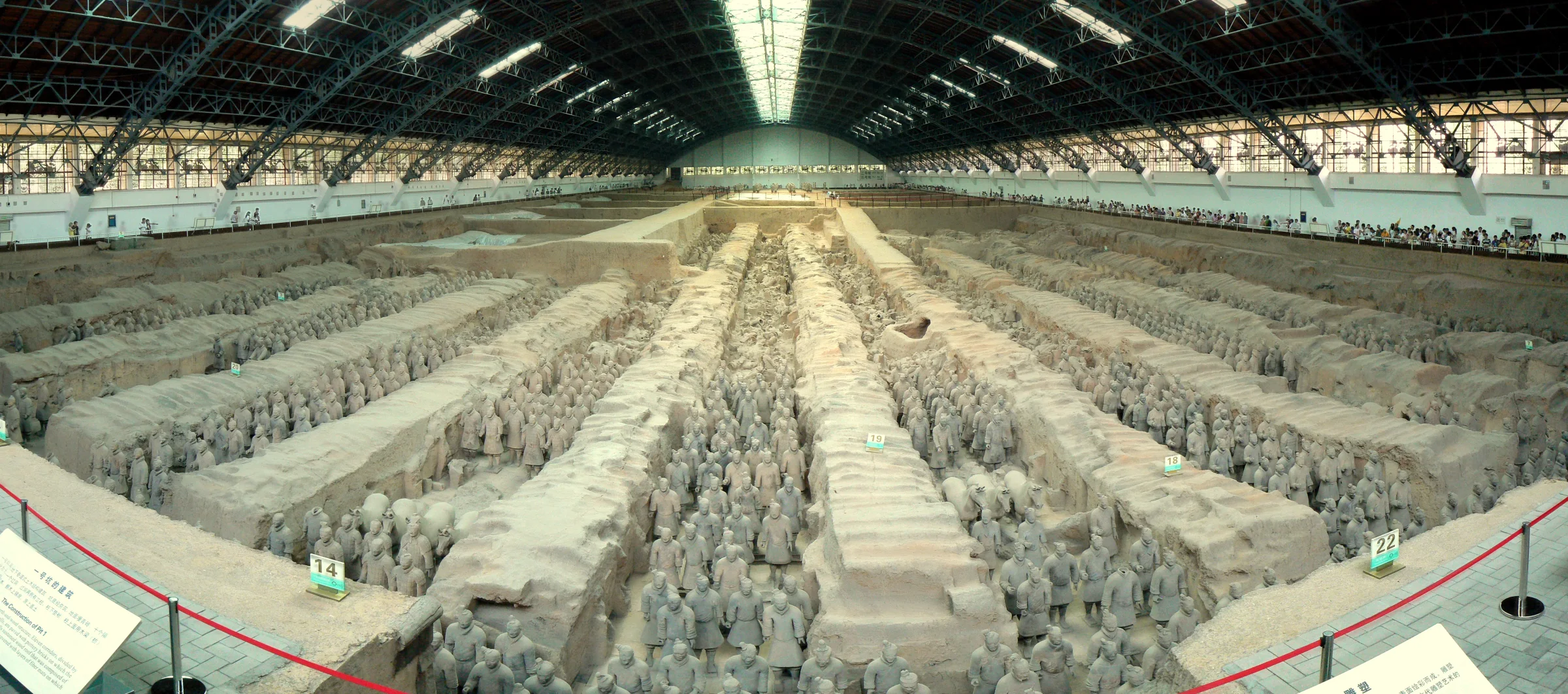
The Terracotta Army is part of Emperor Qinshihuang’s Mausoleum Site Museum, not a stand-alone city-center attraction. In March 1974, local farmers found terracotta fragments while digging a well; the museum opened to the public on October 1, 1979.
Pit 1 covers 14,260 square meters and is estimated to contain about 6,000 terracotta figures and horses. Treat that figure as an archaeological estimate, not a count of fully excavated or currently visible statues.
Plan the visit around the official two-area layout: the Terracotta Army museum area and Lishan Garden, joined by the free shuttle. The museum’s own guide suggests roughly 1.5 hours in each area, before queues and transfers. Reserve with passport details, bring the same original passport, and check the current adult price in official ticketing.
Inside the pits, look beyond the overall scale: hairstyles, armor and stance distinguish different roles, while the restoration area shows how many figures have been reconstructed from fragments. The vast roof and viewing platforms are modern protective infrastructure; the excavated figures and pit remains are the archaeological material.
Xi’an City Wall / 西安城墙
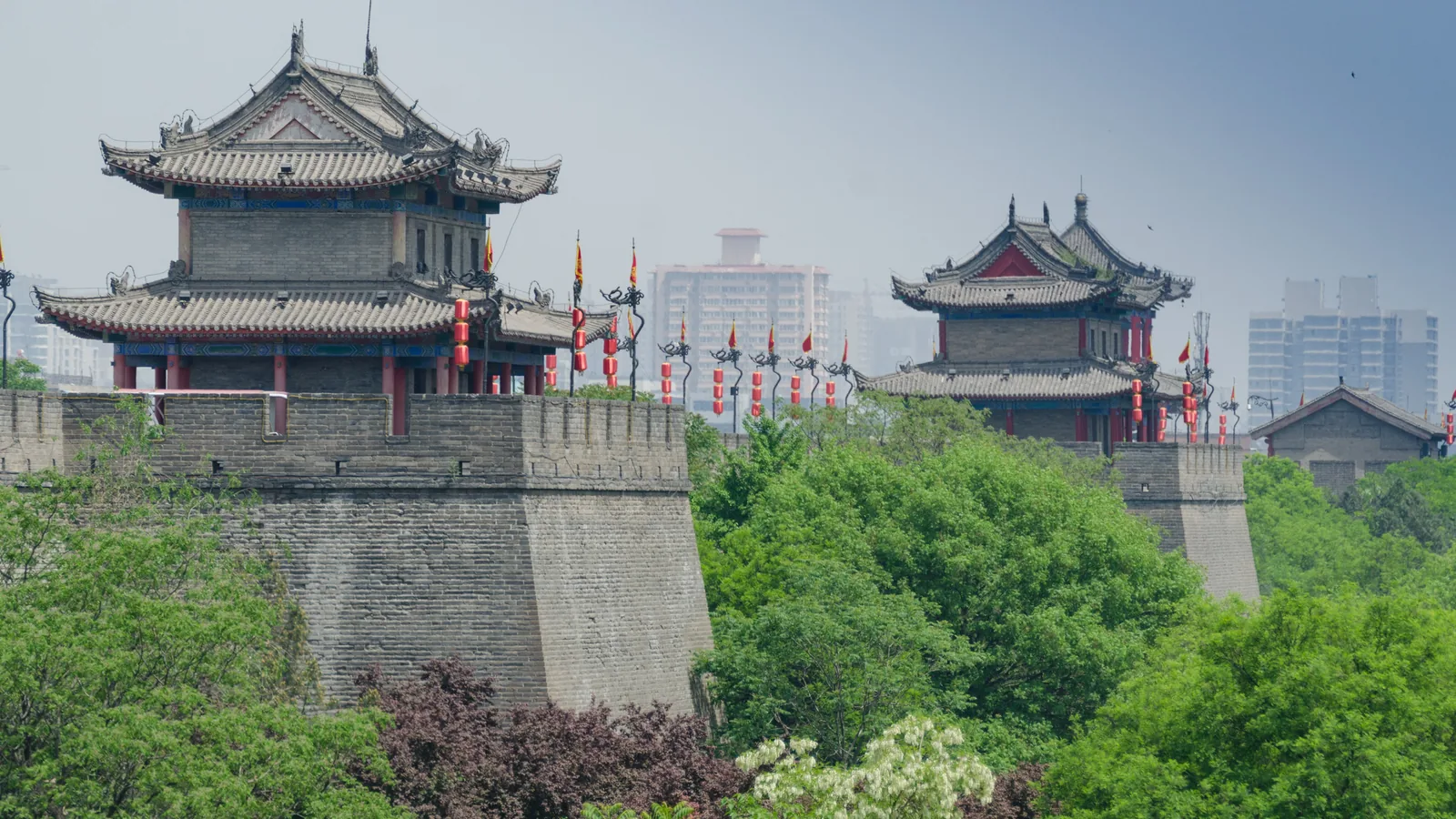
The city wall gives Xi’an’s old center a strong physical boundary and is especially useful for understanding the relationship between the historic core and the modern city. Walking a section can be more rewarding than trying to complete a circuit on a tight itinerary.
Cycling access, rentals, gate hours, tickets, and evening events are operational details that can change. Check the wall’s current official listing and the weather before committing to a particular gate or activity.
For most travelers, a short walk or partial ride is a better default than treating the entire circuit as a requirement. The exposed brick surface offers little shade, and rain can make cycling uncomfortable or unsafe.
Big Wild Goose Pagoda and Daci’en Temple / 大雁塔·大慈恩寺
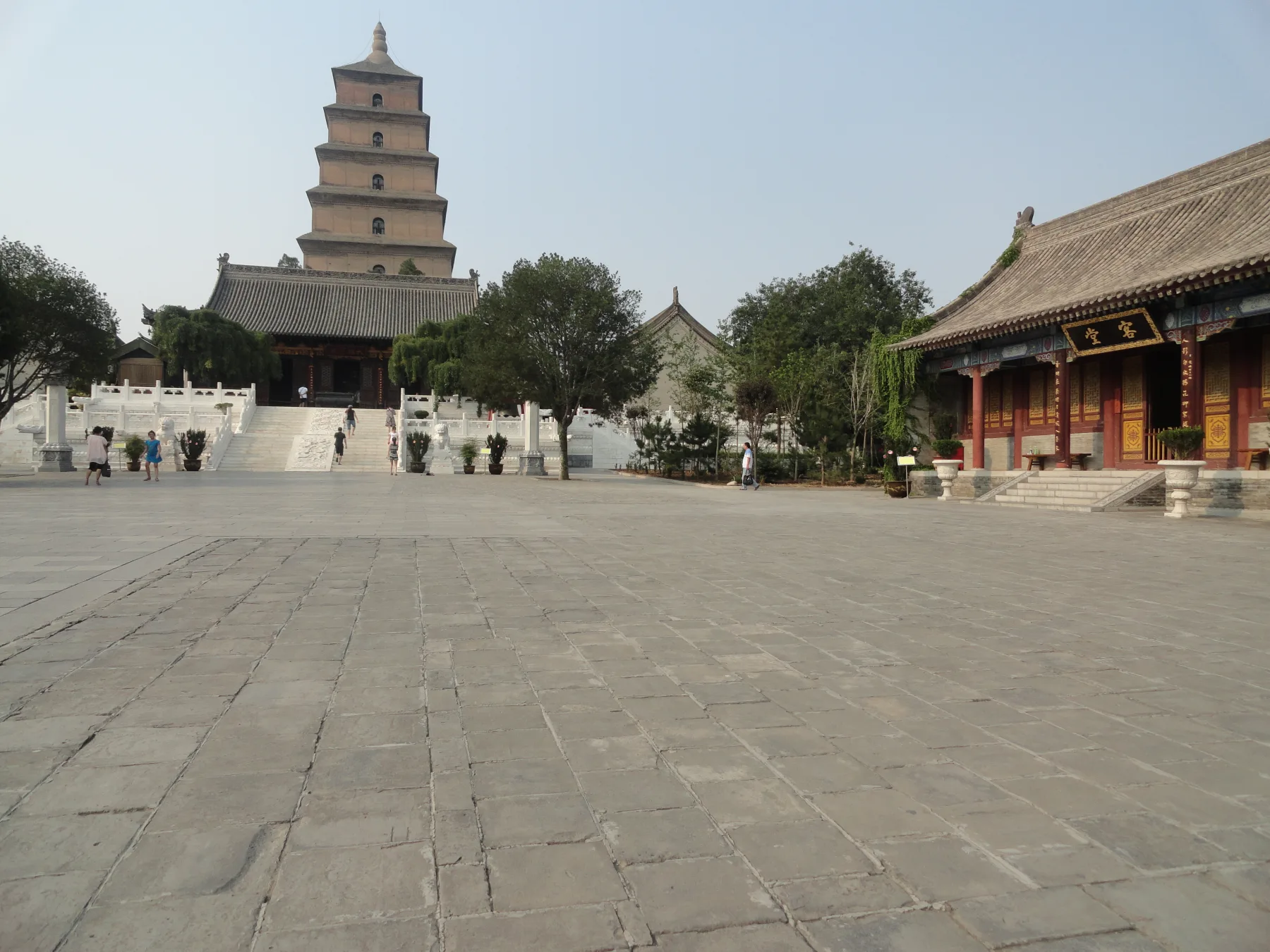
The Big Wild Goose Pagoda (大雁塔) and Daci’en Temple (大慈恩寺) are associated with Xi’an’s Buddhist and Silk Roads history, particularly the monk and translator Xuanzang (玄奘). The surrounding district is also a popular evening walking area.
Treat temple admission, pagoda access, fountain shows, and evening performance times as live information. Check the current operator notice locally rather than using a fixed schedule from this guide.
Muslim Quarter and Great Mosque / 回民街·化觉巷清真大寺
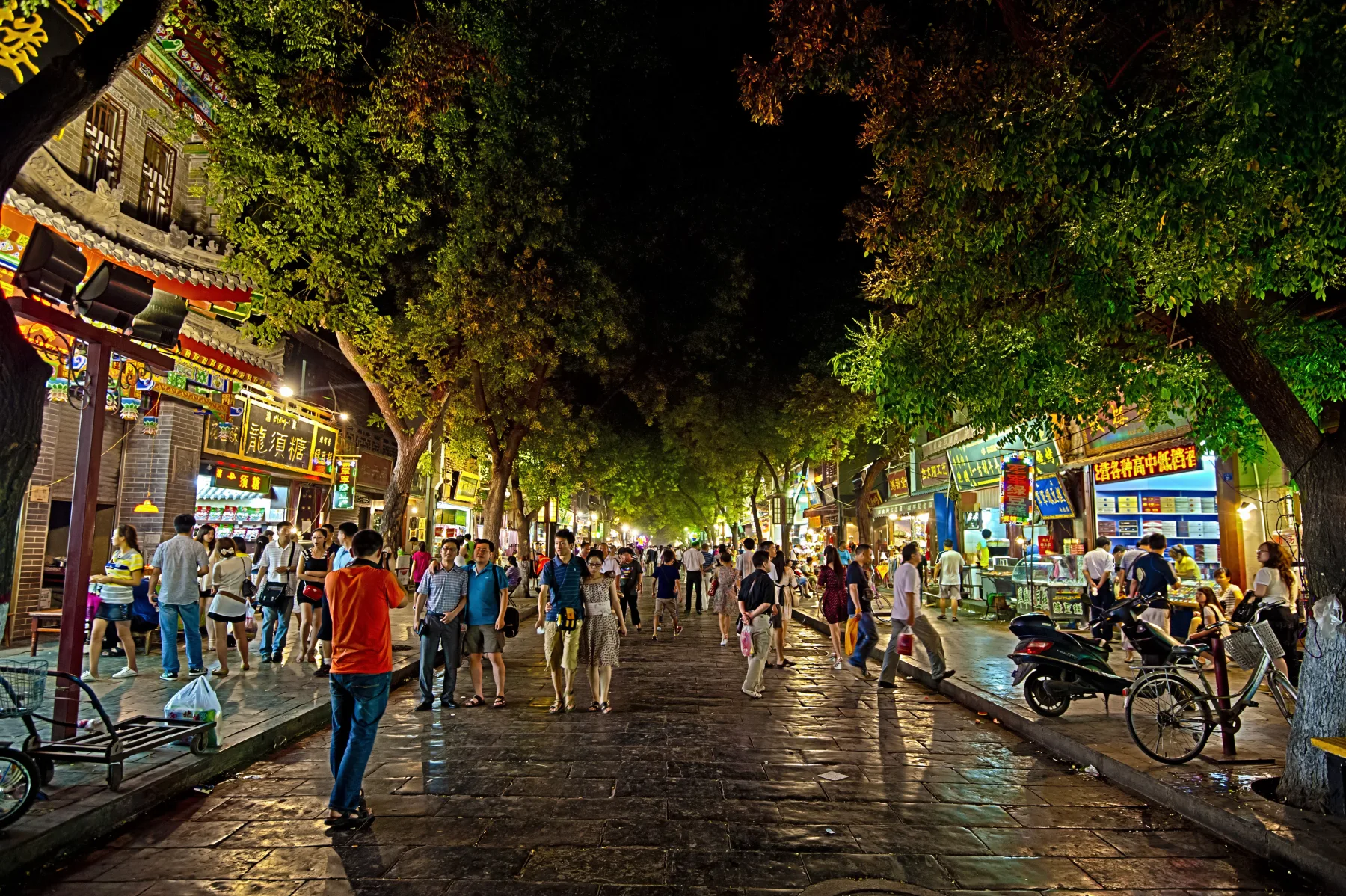
The Muslim Quarter is a living Hui neighborhood as well as a visitor food area. Explore beyond the busiest entrance streets, behave respectfully around residents and worshippers, and ask before photographing people at close range.
The Great Mosque (化觉巷清真大寺) combines Chinese architectural forms with Islamic religious use. Claims that it is definitively China’s “oldest” or “largest” mosque depend on how those terms are defined and are not presented here as verified facts. Visitors should check current admission, opening arrangements, and prayer-time restrictions with the mosque before going.
Bell Tower and Drum Tower / 钟楼·鼓楼
The Bell Tower (钟楼) and Drum Tower (鼓楼) are central orientation points and work well as part of an old-city walk. Their current ticket prices, closing times, combined-ticket arrangements, passport rules, lighting, and performance schedules require a fresh check from the official operator.
Shaanxi History Museum / 陕西历史博物馆
The Shaanxi History Museum is a useful complement to the Terracotta Army because it places objects from different periods into a broader regional story. Ignore marketing claims such as “China’s hardest museum reservation”; the useful planning fact is that a reservation is required and slots can be competitive.
Reserve five days ahead at 17:00 through the official WeChat account; slots go fast. The basic exhibition is free with reservation, while the Tang tomb mural gallery uses a separate paid ticket. Use a passport to reserve and bring the matching original document. Current dated hours are on the Place card above.
If you do not secure a reservation, do not buy an unofficial package merely because it implies guaranteed free-entry access. Rebuild that half-day around Xi’an Museum and Small Wild Goose Pagoda after checking their current admission arrangements, or move the museum visit to a day for which you obtain an official slot.
Stele Forest Museum / 西安碑林博物馆
The Stele Forest Museum (西安碑林博物馆) is best suited to travelers interested in calligraphy, inscriptions, and the preservation of written history. Hours, ticket prices, closure days, and passport procedures can change, so check the museum’s current official visitor notice rather than relying on old listings.
Huaqing Palace and Mount Li / 华清宫·骊山
Huaqing Palace (华清宫) is commonly visited for its imperial-resort associations and modern historical memory. It can be paired geographically with the Terracotta Army, but doing both comfortably depends on reservation times, transport, and energy.
Admission, opening hours, and the schedule and price of The Song of Everlasting Sorrow (长恨歌) change by date and performance. Use the current official listing rather than the old figures previously published on this page.
Small Wild Goose Pagoda and Xi’an Museum / 小雁塔·西安博物院
The Small Wild Goose Pagoda (小雁塔) and Xi’an Museum (西安博物院) offer a quieter alternative to Xi’an’s headline sights. Current opening days, reservations, tower access, and exhibition arrangements need to be checked with the venue.
Classic routes
One focused day
Spend the main part of the day at the Terracotta Army, allowing time for both museum areas and the shuttle. Return to central Xi’an for a relaxed dinner rather than adding another reservation-heavy museum.
Two days
- Day 1: Terracotta Army and, only if timing works, a separately booked Huaqing Palace visit.
- Day 2: City-center walk, one museum or religious site with confirmed opening arrangements, then the pagoda district or old city in the evening.
Three days
Use the third day for the Shaanxi History Museum, Stele Forest Museum, or a slower food-and-neighborhood day. Build the order around the museum reservation you actually secure, not a rigid template.
Food to try
Xi’an cooking is closely associated with wheat-based staples, beef and lamb dishes, assertive seasoning, and Hui Muslim food traditions. Food history is often retold through colorful origin stories; enjoy those stories as local culture unless a specific claim has been independently sourced.
- Biangbiang noodles (油泼扯面 / biángbiáng miàn): Wide hand-pulled noodles, often dressed with chili, aromatics, and vinegar.
- Roujiamo (肉夹馍): A crisp flatbread filled with chopped meat. Hui stalls commonly use beef or lamb; other shops may use pork.
- Yangrou paomo (羊肉泡馍): Flatbread broken into a mutton broth, usually with noodles or vermicelli and condiments.
- Liangpi (凉皮): Cool, chewy noodles dressed with chili oil, vinegar, and vegetables.
- Dumpling banquet (饺子宴): A restaurant-format meal built around multiple dumpling fillings and shapes; compare recent reviews before choosing a venue.
- Local breakfasts and snacks: Look for savory buns, soups, noodles, persimmon-based sweets, and seasonal fruit drinks, but let hygiene, turnover, and your dietary needs guide the choice.
In the Muslim Quarter, treat the streets as a neighborhood network rather than a single “best” strip. Dapiyuan (大皮院), Xiyangshi (西羊市), and Sajinqiao (洒金桥) are useful names to explore, but “authentic” is subjective and businesses change. For halal food, look for clear halal signage and ask the vendor; do not infer ingredients from the neighborhood alone.
Night experience
Good evening options include an old-city walk, the pagoda district, the Muslim Quarter, and the lanes near the city wall. Lighting, fountain shows, cultural performances, bicycle rental, and last-entry times can change without matching older English-language pages. Check same-day official notices and keep a weather-proof alternative.
For The Song of Everlasting Sorrow, verify the operating season, show time, seat category, transport after the performance, and refund policy directly with the current official seller before paying.
Best time to visit
Spring and autumn usually offer the most comfortable balance for walking. Summer can be hot and crowded, while winter can be colder and quieter. Weather varies from year to year, so use a live forecast instead of planning around temperature ranges in an evergreen guide.
Chinese public holidays can sharply increase demand for trains, hotels, and attractions. During peak dates, secure the reservations that matter first, start early, and keep one flexible block in the itinerary.
Culture and history
Xi’an, historically known as Chang’an (长安), served as a capital during multiple periods of Chinese history. Popular sources disagree on exactly how many dynasties should be counted, so “capital of 13 dynasties” is best treated as a familiar tourism shorthand rather than a settled official statistic.
The UNESCO World Heritage property Silk Roads: the Routes Network of Chang’an-Tianshan Corridor was inscribed in 2014. UNESCO describes a corridor of about 5,000 km with 33 component properties. The listing supports Xi’an’s broader Silk Roads context, but the summary page does not by itself verify every site-specific claim made about individual Xi’an attractions.
Xi’an’s cultural identity also reflects Buddhist scholarship, imperial history, regional migration, and a long-established Hui Muslim community. These traditions are visible in religious sites, museums, street patterns, and food. Avoid flattening them into a single “Tang theme” or treating an active religious neighborhood as a staged attraction.
Accessibility and practical tips
- Confirm access directly: Step-free routes, elevators, wheelchair loans, shuttle assistance, and accessible toilets differ by venue and can change. Contact the current operator before booking if a specific facility is essential.
- Allow recovery time: The Terracotta Army involves large visitor areas, transfers, and hard walking surfaces. The official guide suggests about 1.5 hours in each of its two areas, before queues.
- Carry the correct original document: The Terracotta Army and Shaanxi History Museum require the original passport used for the reservation. For other attractions, check the current official listing rather than assuming the same rule applies everywhere.
- Prepare names in Chinese: Save your hotel, station, and attraction names in Chinese characters for navigation and ride-hailing.
- Plan for weather and crowds: Bring water and sun or rain protection, and avoid overloading the middle of a hot day.
Common mistakes
- Booking the Terracotta Army with one passport number and bringing a different document.
- Visiting only the Terracotta Army pits and overlooking Lishan Garden, the second museum area connected by the free shuttle.
- Treating the current Shaanxi History Museum summer-to-autumn timetable as a permanent year-round schedule.
- Assuming a free museum exhibition means no reservation is needed.
- Using old third-party prices, opening hours, booking windows, or performance times as if they were current official policy.
- Confusing Xi’an Station with Xi’an North Railway Station.
- Trying to combine two demanding, reservation-heavy museums in one rushed day.
- Repeating tourism superlatives as verified history without checking how the claim is defined.
Sources
- National Immigration Administration: 240-hour visa-free transit
- Emperor Qinshihuang’s Mausoleum Site Museum: overview
- Emperor Qinshihuang’s Mausoleum Site Museum: visitor guide
- Emperor Qinshihuang’s Mausoleum Site Museum: ticketing notice
- Emperor Qinshihuang’s Mausoleum Site Museum: Pit 1
- Shaanxi History Museum: visitor guide
- UNESCO: Silk Roads, Chang’an-Tianshan Corridor
- China Railway 12306 English FAQ