
Current visitor details
Hours, admission, booking and passport guidance below come from the Place record shared by city, itinerary and booking pages. Unverified or stale high-risk claims are not shown as facts.
Booking
Advance reservation is not normally required. Buy the 10-RMB temple ticket on arrival, then add the separate 25-RMB pagoda-climb ticket only if you want to climb.
Plan ahead: No advance booking is normally needed; allow extra time on national holidays.
On site: Available at the temple ticket office and is the normal, reliable option.
Channels: WeChat: 大慈恩寺 · Ctrip / OTA · On-site ticket office
Foreign passport
For a staffed-window purchase, carry the original passport. Advance reservation is not normally necessary; the online foreign-passport payment flow is not presented as guaranteed.
Opening and last entry
Daci'en Temple admission runs 08:30-17:00, with the grounds cleared by 18:00. The pagoda is inside the temple and may stop admitting climbers before the temple grounds close.
Admission
Daci'en Temple admission is 10 RMB. Climbing the Giant Wild Goose Pagoda is a separate 25 RMB ticket, so visiting both costs 35 RMB per adult. North Square and Grand Tang Mall outside the temple are free.
Visit planning
Allow: 1-1.5 hours (temple grounds); 2 hours with the pagoda climb and fountain
Physical load: moderate
Late afternoon for the best light; enter Daci'en from the south, climb the pagoda, exit to North Square for the fountain, then walk south to Grand Tang Mall for the night lights.
Getting there
Metro Line 3 or 4 to Dayanta Station (大雁塔站), then 5-10 minutes on foot.
Walk from Shaanxi History Museum: ~1.2 km southeast, 15-20 minutes.
Accessibility
- Wheelchair access: The temple grounds are mostly flat and accessible; the pagoda climb is steep stairs only, with no elevator.
Who this visit suits
This page is for visitors drawn to Tang history and Silk Road heritage, anyone wanting panoramic views over southern Xi’an, and travelers combining culture with an evening of fountains, lights, and entertainment. It pairs naturally with the Shaanxi History Museum, a short walk away. It is less ideal for visitors with limited mobility (steep wooden stairs, no elevator in the pagoda), visits under an hour, and itineraries that attempt to combine the pagoda with the Terracotta Warriors on the same day.
A route that makes sense
Visit late afternoon into evening to see the temple in daylight and the fountain and mall after dark.
- Enter Daci’en Temple through the south gate. Pass through temple courtyards with halls, incense burners, and active monastic buildings. Dress modestly.
- Visit the main halls. Pause at the Mahavira Hall and Xuanzang memorial areas telling the story of his 17-year journey to India.
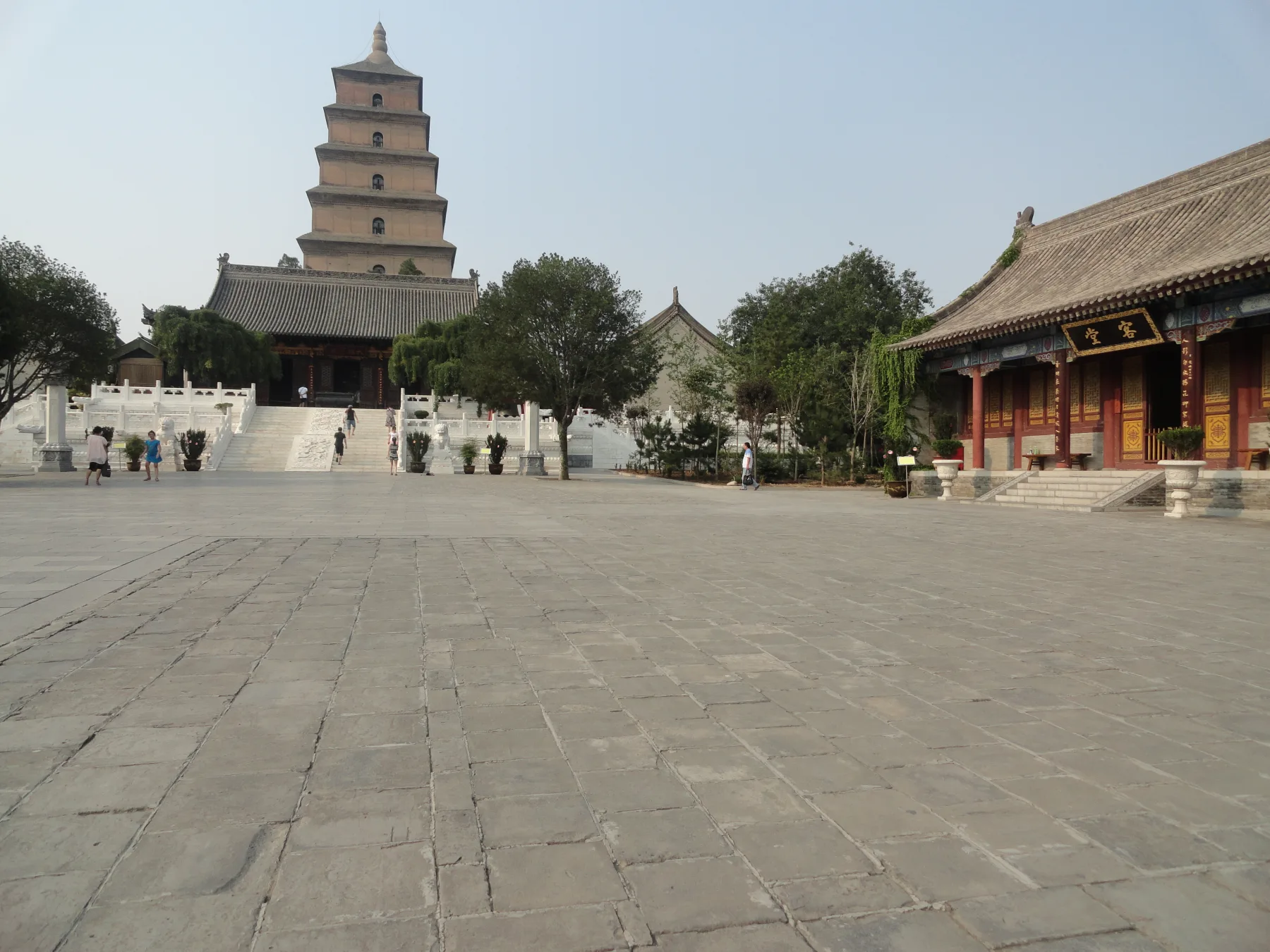
- Approach the pagoda. Walk around its base to examine the simple brick silhouette and tiered eaves of classic Tang design.
- Views from the top. Look south over Datang Everbright City and north toward central Xi’an. Relics and palm-leaf scriptures are displayed on various levels.
- Exit the temple and head to the north square.
- North square musical fountain. One of Asia’s largest matrix fountains, especially atmospheric when lit after dark. Show times vary seasonally; check locally or the info card.
- Datang Everbright City. Walk south along the pedestrian mall past Tang-themed sculptures, lanterns, and performers. Free entry, liveliest in the evening.
What to notice
The pagoda’s architecture is intentionally simple and massive: a square-plan brick structure with seven tiers of evenly spaced eaves, reflecting early Tang monumental restraint. The walls are weathered warm grey, and the structure leans noticeably after centuries of foundation shifts. Inside, steep wooden stairs worn smooth by centuries of use narrow on upper floors; the climb feels like ascending a historic structure, not a modern attraction. Pause at the windows on each level for changing views. Around the courtyards, notice incense, chanting monks, and worshippers at the halls; this is an active monastery, not a museum-only site. The Xuanzang statue in the south square shows the monk in traveling robes. After dark, the fountain draws crowds with water jets dancing under colored lights, and Datang Everbright City is a lively Tang-themed pedestrian strip with sculptures, lanterns, and performers.
Accessibility, fitness and conditions
Temple courtyards are paved and generally accessible for wheelchairs, though some halls have steps. The pagoda interior is not wheelchair accessible; steep, narrow wooden stairs, no elevator. Visitors who cannot climb can still enjoy the pagoda exterior and temple halls. The north square and Datang Everbright City are flat, open pedestrian areas.
The pagoda climb is moderately strenuous but brief: 15 to 25 minutes up and down at a relaxed pace.
Crowds peak on weekends, holidays, and during evening fountain shows. The temple is quieter in the morning before tour groups arrive. Summer is hot; the grounds have some shade, but the open squares are exposed until evening. Spring and autumn are best for temple wandering. Evening visits are pleasant year-round.
How to combine it with nearby places
- Shaanxi History Museum is a 15- to 20-minute walk north and is the natural morning pairing.
- Small Wild Goose Pagoda is further west and best saved for a separate day.