
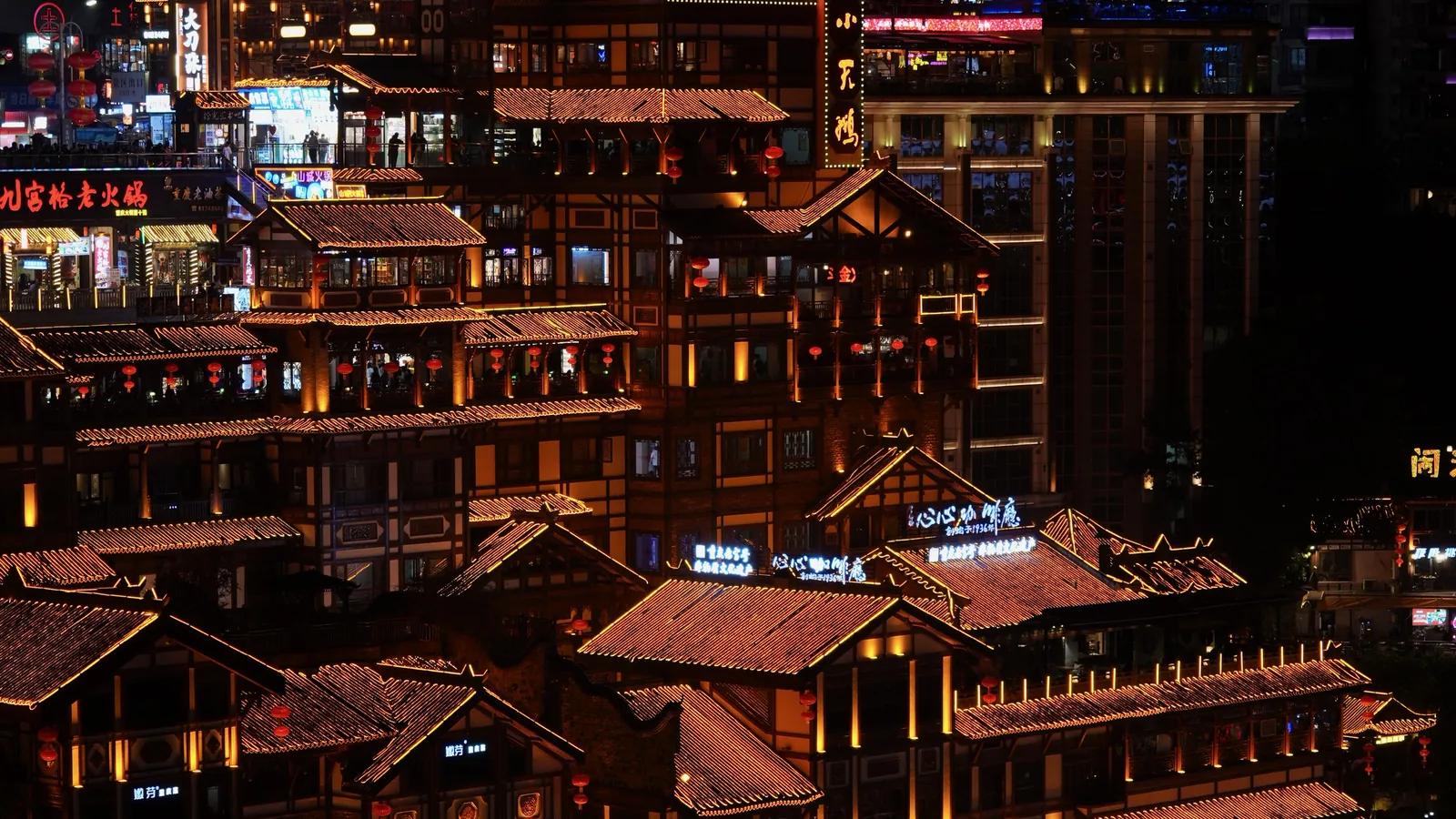
Chongqing places at a glance
These cards are rendered from the same Place records used by routes and booking guidance. Operational facts are maintained once.

Hongya Cave
洪崖洞A steep riverside commercial complex whose layered façades make Chongqing's vertical geography immediately legible, especially after dark.
- Booking
- Verify the current booking channel before relying on it.
Jiefangbei Pedestrian District
解放碑步行街The central commercial district around the Liberation Monument, useful as a first-night orientation point and a base for nearby riverfront sights.
- Booking
- Verify the current booking channel before relying on it.
Shibati Traditional Style Area
十八梯A restored stair-lane district that makes Chongqing's upper-city and lower-city relationship visible through terraces, slopes and layered alleys.
- Booking
- Verify the current booking channel before relying on it.

Yangtze River Cableway
长江索道A short aerial crossing of the Yangtze that combines public-transport history with broad views of Chongqing's riverbanks and layered skyline.
- Booking
- Verify the current booking channel before relying on it.
Liziba Monorail Viewpoint
李子坝轻轨穿楼A quick urban stop where Chongqing's Line 2 monorail passes through a building, vividly showing how the city fits transport into steep terrain.
- Booking
- Verify the current booking channel before relying on it.

Ciqikou Ancient Town
磁器口古镇A hillside market district with timber-fronted lanes, snack shops and teahouses that offers an easy introduction to Chongqing's older street texture.
- Booking
- Verify the current booking channel before relying on it.
Three Gorges Museum
重庆中国三峡博物馆Chongqing's major museum for the Three Gorges region, Ba-Yu culture and the city's wartime-capital history.
- Booking
- Verify the current booking channel before relying on it.
Chongqing Zoo
重庆动物园A large urban zoo best known to visitors for its giant pandas, with enough walking to treat it as a substantial half-day stop.
- Booking
- Verify the current booking channel before relying on it.
Dazu Rock Carvings
大足石刻A major ensemble of Buddhist, Daoist and Confucian rock carvings spread across sites outside central Chongqing, rewarding a dedicated day trip.
- Booking
- Verify the current booking channel before relying on it.
Wulong Karst
武隆喀斯特A dramatic karst landscape of natural bridges, gorges and forested sinkholes that works as a full-day or overnight escape from the city.
- Booking
- Verify the current booking channel before relying on it.
Chongqing local dishes to try

Chongqing Hotpot 重庆火锅
A communal, intensely aromatic hotpot centered on beef tallow, dried chilies and Sichuan pepper, with diners cooking ingredients at the table.
Chongqing Xiaomian 重庆小面
A compact bowl of wheat noodles whose character comes from a layered seasoning base rather than a heavy topping.
Suanla Fen 酸辣粉
Springy sweet-potato noodles in a sharp, spicy and sour broth, commonly finished with peanuts, greens and preserved vegetables.
Jianghu Cuisine 江湖菜
A broad Chongqing style of bold, informal dishes known for assertive seasoning, generous portions and restaurant-specific specialties.
Douhua Rice 豆花饭
Soft tofu served with rice and a powerful dipping sauce, offering a comforting, less elaborate counterpoint to Chongqing's famous hotpot.
Chongqing route modules
Chongqing Essential First Day
This first-day route explains Chongqing before it tries to maximize attractions. Jiefangbei gives you a level central reference point, Shibati reveals how upper and lower streets connect, and Liziba turns the city's improbable transport geography into something visible. Finish at Hongya Cave only after you understand the vertical terrain around it. The sequence works best with small bags, comfortable shoes and enough flexibility to change a transfer when elevation makes the map misleading.
- Jiefangbei Pedestrian District
- Shibati Traditional Style Area
- Liziba Monorail Viewpoint
- Hongya Cave
Jiefangbei, Shibati and Hongya Evening
Use this evening to read central Chongqing as a sequence of levels rather than three disconnected photo stops. Begin amid Jiefangbei's modern commercial grid, descend through Shibati's restored stair lanes, then reach the river for Hongya Cave's exterior view. The downhill direction is generally kinder than reversing the route, but there are still many steps. Keep the final viewpoint flexible because lighting and crowd controls can change with season, weather and major events.
- Jiefangbei Pedestrian District
- Shibati Traditional Style Area
- Hongya Cave
Liziba and Ciqikou Urban Day
This route pairs two very different versions of Chongqing: infrastructure squeezed into the mountain at Liziba and older market lanes at Ciqikou. Treat Liziba as a short observation and transit experience rather than a half-day attraction, then give Ciqikou enough time to leave the main shopping street and explore quieter side lanes. It is a practical lower-intensity day, but the ancient-town slopes still make supportive footwear worthwhile.
- Liziba Monorail Viewpoint
- Ciqikou Ancient Town
Dazu Rock Carvings Day Trip
Dazu deserves its own day because the value lies in reading sequences of carvings slowly, not collecting a quick UNESCO photograph. Start early, keep the route centered on one principal carving area, and protect time for the return journey. Steps, weather and inter-site distance matter more than the number of named stops. Travelers with limited mobility should confirm the exact section they plan to visit and avoid combining Dazu with Wulong or another remote attraction.
- Dazu Rock Carvings
Wulong Karst Day Trip
Wulong is a landscape day, not a collection of city attractions. Choose one primary karst experience and build the transport around it rather than trying to cover every scenic zone. Long descents, shuttle segments and weather can absorb more time than a map suggests. Keep luggage in the city, wear shoes with grip and retain a cancellation option for severe rain. An overnight stay is the better choice when you want more than one major scenic area.
- Wulong Karst
Chongqing Rain, Heat or Fog Fallback
When rain, summer heat or dense fog removes the value from distant viewpoints, use the day for context and flexible indoor time. The Three Gorges Museum explains the river region and wartime city, while Jiefangbei provides covered malls, restaurants and easy transport choices. This fallback intentionally avoids promising a particular temporary exhibition or skyline. If the museum is closed, keep the central food component and substitute another currently open cultural venue after checking its live notice.
- Three Gorges Museum
- Jiefangbei Pedestrian District
Chongqing context worth knowing
Mountain-City Urban Form 山城城市形态
Chongqing's steep terrain produces stacked roads, bridges, elevators and buildings whose apparent ground floor changes with elevation.
- Navigation is three-dimensional: nearby points on a map may sit on different levels.
- Bridges, monorails and hillside buildings are part of daily infrastructure, not isolated spectacles.
- Walking routes are best planned around elevation and access points, not straight-line distance.
Yangtze and Jialing River Culture 两江文化
The meeting of the Yangtze and Jialing rivers shaped Chongqing's trade, transport, neighborhoods and panoramic identity.
- River crossings organize how the city is perceived and moved through.
- Ports and steep riverbank settlements connected inland trade routes.
- Modern skyline views still make the confluence central to Chongqing's identity.
Wartime Capital History 重庆抗战陪都历史
During the War of Resistance against Japan, Chongqing served as China's wartime capital and endured sustained aerial bombing.
- The wartime-capital period transformed Chongqing's national political role.
- Museums and memorials connect city streets to displacement, industry and civilian survival.
- This history belongs in twentieth-century context rather than as decorative nostalgia.
Ba-Yu and Three Gorges Culture 巴渝与三峡文化
Ba-Yu culture and the Three Gorges link Chongqing to a wider river region of archaeology, migration, folklore and changing landscapes.
- Chongqing's history predates its modern municipality identity.
- The Three Gorges are a cultural region as well as a physical landscape.
- Museum collections help connect local objects to the wider Yangtze basin.
Chongqing Teahouse Culture 重庆茶馆文化
Neighborhood teahouses offer a slower social counterpoint to Chongqing's intense streets, preserving routines of conversation, cards and everyday observation.
- The experience is social and unhurried rather than a formal tea ceremony.
- Older teahouses often matter for their neighborhood setting as much as their tea.
- Visitors should observe first and avoid turning regular customers into a performance backdrop.
Quick answer
Chongqing is worth choosing when the city itself is the attraction. Streets stack above one another, bridges cross deep river valleys, and what looks close on a flat map may sit several levels away. The strongest first visit combines one day learning the central peninsula, one day exploring a contrasting neighborhood, and an optional full-day escape to Dazu or Wulong.
This is a visually rewarding city, but it asks more from your legs and navigation than Beijing, Shanghai or Guangzhou. Treat stairs, slopes and transfers as part of the itinerary rather than wasted time.
Booking warnings
Do not copy an old ticket price or timetable into your itinerary. Use the Place cards on this page for the latest maintained status, then confirm the linked official channel before payment. For foreign visitors, keep the physical passport available and allow a staffed counter as a fallback whenever an online identity flow is unclear.
Best Areas to Stay
Jiefangbei is the easiest first base: central, lively and close to the most recognizable evening scenes. Nanbin Road works for river views and a calmer night, but adds cross-river transfers. Guanyinqiao suits travelers prioritizing local dining and nightlife over doorstep sightseeing. Shapingba makes sense when Ciqikou or a western-side plan is central to the trip.
When comparing hotels, check the entrance level and nearest useful transit exit—not only the map distance. A short horizontal distance can hide a demanding climb.
Arrival & Transport
Chongqing has multiple railway stations and an airport with more than one passenger terminal, so match the exact name on the ticket before leaving. Within the city, rail transit and taxis complement each other: rail avoids road congestion, while a short taxi can save a punishing elevation change.
For walking, use a current China-capable map and still read street signs and building levels. If a route appears to pass through a building or jump between parallel roads, pause and confirm the correct floor before continuing. See the high-speed rail guide and internet and maps guide before arrival.
Top Sights
Start with the canonical Place cards above. Hongya Cave is strongest as an exterior cityscape; Jiefangbei and Shibati explain the central peninsula; Liziba makes the city’s transport geometry visible; and the cableway turns the river crossing into the experience itself. Ciqikou adds an older market-town texture, while the Three Gorges Museum provides regional context.
Dazu Rock Carvings and Wulong Karst are separate full-day commitments. They are not sensible add-ons to an already full urban day.
Classic Routes
For two days, use Chongqing Essential First Day followed by Liziba & Ciqikou Urban Day. With a third day, choose either an evening-focused central route plus a slower food morning, or one of the two major day trips. With four days, keep one weather-flexible block instead of forcing every landmark into fixed slots.
The route modules above carry the reusable stop order and fallback logic. They intentionally avoid embedding operational details that can change.
Food to Try
Chongqing hotpot is the headline, but it should not crowd out xiaomian, sour-and-spicy sweet-potato noodles, douhua rice and the broader family of bold jianghu dishes. If you are sensitive to heat, ask for a mild or split pot and order cooling side dishes; “not spicy” may still taste hot to an unfamiliar palate.
Food blocks above explain what each dish is and how to approach it without tying the guide to one restaurant or a temporary menu.
Night Experience
The city changes character after dark, especially around the central peninsula and the two rivers. Build the evening around one main viewpoint or walking sequence, not a race among every illuminated landmark. Hongya Cave, the Jiefangbei–Shibati descent and a south-bank view are alternatives with different crowd and effort profiles.
Best Time to Visit
Spring and autumn usually make long outdoor days easier. Summer heat amplifies the effort of hills and stairs; rain and fog can reduce distant views while making surfaces slippery. Keep the weather fallback module available and move museum or food time forward when visibility collapses.
Culture & History
Chongqing is more than a “cyberpunk” photo backdrop. Its urban form grows from mountain ridges and two rivers; its wartime-capital history explains a different layer of the modern city; Bayu and Three Gorges culture connect it to a wider regional story. Teahouses offer a quieter counterpoint to the fast, vertical streets.
The Culture blocks above separate these ideas so other routes and pages can reuse them without repeating the same paragraph.
Accessibility & Tips
Assume a heavy physical load for central sightseeing. Elevators and escalators exist, but they do not turn every route into a step-free route. Travelers with limited mobility should choose fewer stops, use taxis between elevations, verify access at each Place, and avoid treating Wulong as a casual excursion.
Carry the destination name and hotel address in Chinese. If navigation fails, return to a clear landmark or staffed station entrance rather than following increasingly improbable walking directions.
Common mistakes
- Planning by flat-map distance instead of elevation.
- Trying to combine Wulong or Dazu with central-city sightseeing.
- Treating Hongya Cave as an ancient preserved town rather than a modern commercial complex with a traditional visual language.
- Assuming every online ticket flow accepts a foreign passport just because a passport is accepted at the attraction.
- Scheduling every evening viewpoint and spending the whole night in transit.
Extend the route when you have more time
Use a destination as an anchor, then add nearby or well-connected places instead of stretching one city across the whole trip.