
Beijing places at a glance
These cards are rendered from the same Place records used by routes and booking guidance. Operational facts are maintained once.

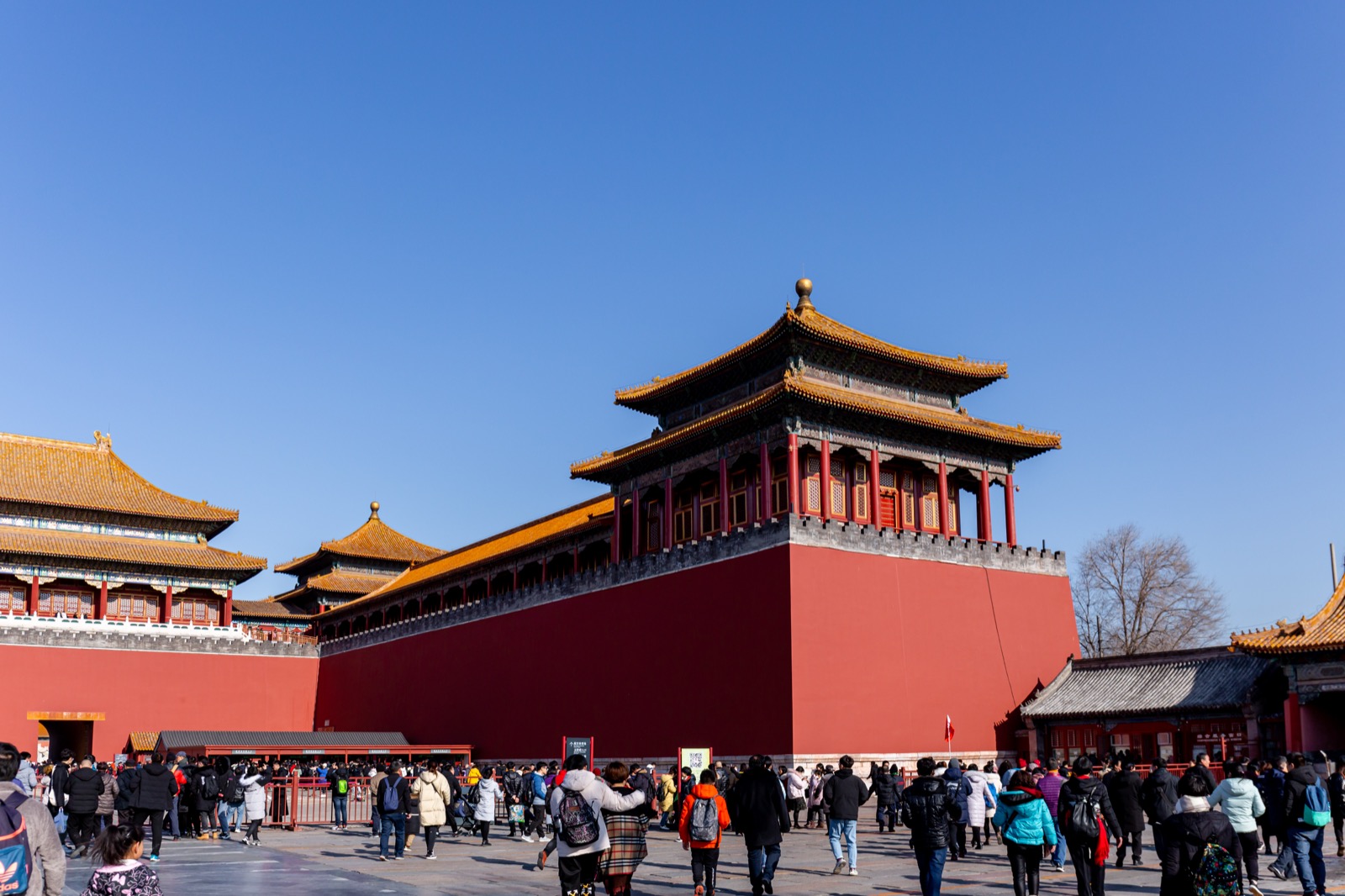
The Palace Museum
故宫博物院The imperial palace complex was constructed from 1406 to 1420 and entered the UNESCO World Heritage List in 1987.
- Booking
- Advance real-name online booking is required via the Meridian Gate (午门, south) as the ONLY entrance; exit via Shenwu (north) or Donghua (east) Gate. Bring the same identity document used for booking.
Current practical details
- Passport
- Non-mainland visitors book and enter with a Mainland Travel Permit for Hong Kong/Macao residents, Mainland Travel Permit for Taiwan residents, Residence Permit for Hong Kong/Macao/Taiwan residents, Foreign Permanent Resident ID Card, or passport. Present the original document at the Meridian Gate.
- Hours
- Tuesday-Sunday 08:30-17:00 from April through October, last entry 16:00; 08:30-16:30 from November through March, last entry 15:30. Normally closed Monday except statutory holidays.
- Admission
- Adult admission is RMB 60 from April through October and RMB 40 from November through March; the Treasure Gallery and Clock Gallery are RMB 10 each.

Tiananmen Square & Gate
天安门广场与城楼Tiananmen Square is the ceremonial and political center of contemporary Beijing and one of the world's largest city-center public squares, while Tiananmen Gate is the historic southern entrance to the imperial city. Both are components of the Beijing Central Axis UNESCO World Heritage site (inscribed 2024).
- Booking
- Tiananmen Square and Gate Tower are TWO SEPARATE reservations on different platforms. The square is free but still requires real-name booking; the Gate Tower costs ¥15 and uses its own platform. Book both well in advance. Present the original identity document used for booking at each entry point. Security screening is mandatory at all square entry checkpoints.
Current practical details
- Passport
- Square: book with a passport or Foreign Permanent Resident ID Card and present the original document at the security checkpoint. Gate Tower: the current public instructions do not explicitly confirm the passport workflow, so check the live booking form before planning the ascent.
- Hours
- Tiananmen Square is listed as open daily 05:00-22:00, with entry controlled by security checkpoints and separate flag-raising, morning, afternoon, and flag-lowering reservation periods. Gate Tower admission uses its own reservation system and may close or adjust visit slots for official events; check the live booking page before visiting.
- Admission
- Tiananmen Square: free admission (reservation required, see booking). Tiananmen Gate Tower ascent: adult ticket ¥15, concession ticket ¥5. Free for visitors under 18 and aged 60+ (Chinese citizens, including Hong Kong/Macau/Taiwan residents and foreign permanent residents), active and retired military, firefighters, and disabled visitors.
Jingshan Park
景山公园Jingshan is an artificial hill immediately north of the Forbidden City, piled from the excavated earth of the palace moat in the early Ming dynasty. Its Wanchun Pavilion provides the defining elevated view over the Forbidden City's golden roofs and the Beijing Central Axis, making it the natural coda to a palace visit.
- Booking
- No permanent real-name pre-booking for standard admission. During major holidays, timed entry may apply via the Changyou Park WeChat platform. Foreign visitors can buy at the gate with a passport.
Current practical details
- Passport
- Foreign visitors can purchase admission at on-site ticket windows with a passport. Online booking via the Changyou Park WeChat platform may require Chinese ID and is not confirmed for passport support.
- Hours
- Peak season (April 1 to October 31): 06:00-21:00, last entry 20:30. Off-season (November 1 to March 31): 06:30-20:00, last entry 19:30. Open daily including Mondays.
- Admission
- Standard adult admission is ¥2 outside temporary exhibitions. Temporary exhibitions may use a higher combined admission price; check any current notice before visiting.

Mutianyu Great Wall
慕田峪长城Mutianyu is a Great Wall visitor area in Beijing's Huairou District with cable-car, ropeway, and toboggan facilities.
- Booking
- Real-name reservations can be made up to 30 days in advance, with one ticket per identity document per day.
Current practical details
- Passport
- The official system accepts passports for real-name online booking; visitors enter with the original passport.
- Hours
- Peak season (16 Mar-15 Nov): Monday-Friday 07:30-18:00, Saturday-Sunday 07:30-18:30. Low season (16 Nov-15 Mar): 08:00-17:30. Ticket sales stop one hour before closing; entry stops 30 minutes before closing.

The Temple of Heaven is the ceremonial complex where Ming and Qing emperors performed the annual winter-solstice sacrifice to Heaven; it was inscribed on the UNESCO World Heritage List in 1998.
- Booking
- No permanent real-name pre-booking for standard admission; reserve during peak periods.
Current practical details
- Passport
- Foreign visitors can purchase admission with a passport at official ticket windows and supported online platforms.
- Hours
- Peak season (April 1-October 31): park 06:00-22:00, last entry 21:00; main scenic sights 08:00-18:00, last entry 17:30. Off season (November 1-March 31): park 06:30-22:00, last entry 21:00; main scenic sights 08:00-17:00, last entry 16:30. The main scenic sights close Mondays except statutory holidays; the park grounds remain open.
- Admission
- Peak season: general admission RMB 15 and combo ticket RMB 34. Off season: general admission RMB 10 and combo ticket RMB 28. The combo covers the Hall of Prayer for Good Harvests, Echo Wall, and Circular Mound Altar.

The Summer Palace is a Qing dynastic imperial garden centered on Kunming Lake and Longevity Hill, inscribed on the UNESCO World Heritage List in 1998.
- Booking
- No permanent real-name pre-booking for standard admission; boat rides and combined tickets sold separately.
Current practical details
- Passport
- Foreign visitors can buy tickets with a passport at official windows and supported online platforms.
- Hours
- Peak season (April 1-October 31): entrance gates 06:00-19:00 and the park clears at 20:00; separately charged attractions admit 08:00-17:30 and close at 18:00. Off season (November 1-March 31): entrance gates 06:30-18:00 and the park clears at 19:00; separately charged attractions admit Tuesday-Sunday 08:30-16:30 and close at 17:00.
- Admission
- Park admission is RMB 30 in peak season and RMB 20 in off season. Discount admission is RMB 15 and RMB 10 respectively; separately charged attractions and combined products cost extra.

National Museum of China
中国国家博物馆The National Museum of China is a comprehensive history and art museum on the east side of Tiananmen Square, holding more than one million artifacts across Chinese civilization.
- Booking
- Free general admission, but a timed real-name reservation is required; present the original passport at the north gate.
Current practical details
- Passport
- Foreign visitors register with passport information during reservation and present the original passport for entry at the north gate.
- Hours
- Open Tuesday to Sunday 09:00-17:00, last entry 16:00; closed Mondays except statutory holidays. From June 1 through October 31, closing is extended to 17:30 with last entry at 16:30.
- Admission
- General admission is free; some special exhibitions may require a separate ticket.

Shichahai & Hutongs
什刹海与胡同Shichahai is a network of three connected lakes and historic hutong neighborhoods that provides Beijing's most walkable traditional streetscape, anchored by the Bell and Drum Towers at its north end. It developed outside the imperial city walls as a residential and commercial area serving the Grand Canal's terminal water system during the Yuan and Ming dynasties.
- Booking
- No booking required for Shichahai public areas — lakes, hutong streets, Yandai Xiejie, and Silver Ingot Bridge are all open-access public spaces.
Current practical details
- Passport
- No identity document required for public hutong streets and lakes (open public space).
- Hours
- The lakes, public hutong streets, and Yandai Xiejie are open public spaces with no gates or closing times. Individual businesses (cafes, shops) set their own hours, typically late morning through night. The Houhai bar and restaurant strip is most active in the evening.
- Admission
- Free public access — the lakes, hutong streets, Yandai Xiejie, and Silver Ingot Bridge are all open public spaces with no admission fee.
The Bell and Drum Towers mark the northern terminus of Beijing's historic Central Axis and served as the city's timekeeping center for nearly seven centuries. Their upper levels offer a rare elevated view over the hutong rooftops of Shichahai, but both require climbing steep historic stairs.
- Booking
- No permanent real-name pre-booking required for standard admission. Combo ticket (¥30) covers both towers. Purchase on-site or via WeChat. The Drum Tower is the more popular of the two; the Bell Tower is often quieter.
Current practical details
- Passport
- Foreign visitors can purchase tickets at on-site ticket windows with cash, Alipay, or WeChat Pay. WeChat public account booking may require a Chinese ID; foreign passport support for online booking is not confirmed.
- Hours
- Peak season (March 26 to October 25): 09:30-17:30. Off-season (October 26 to March 25): 09:30-16:30. Ticket sales end 30 minutes before closing. The first-floor exhibition hall of the Drum Tower closes on Mondays except public holidays.
- Admission
- Drum Tower single ticket: ¥20. Bell Tower single ticket: ¥10. Combo ticket for both towers: ¥30. Check the official ticketing account for current concession eligibility.
The Lama Temple is Beijing's most important Tibetan Buddhist monastery and a significant Qing imperial site, housed in the former princely residence of the Yongzheng Emperor and the birthplace of the Qianlong Emperor. It is an active religious site — monks live and practice here, and worshippers burn incense daily.
- Booking
- Real-name ticket reservation is handled through the official WeChat public account (雍和宫游客信众服务). Passport booking is supported; bring the original document. Dress and behave respectfully — this is an active monastery, not a museum.
Current practical details
- Passport
- Foreign visitors can book tickets via the official Yonghegong WeChat public account using a passport number. Present the original passport at the entrance for verification.
- Hours
- Peak season (April 1 to October 31): 09:00-17:00, last entry 16:30. Off-season (November 1 to March 31): 09:00-16:30, last entry 16:00. Open daily including Mondays.
- Admission
- Adult admission ¥25 (half-price ¥12). Free for children under 6 or height under 1.2m, disabled visitors (with disability certificate), active and retired military, firefighters, and holders of Beijing Civil Affairs Preferential Card. Half-price: visitors aged 6-18, full-time students (undergraduate and below), and seniors 60+. Real-name booking required.
Beijing Olympic Park
北京奥林匹克公园Beijing Olympic Park is the landscaped legacy of the 2008 Summer and 2022 Winter Olympics, anchored by two of the most recognizable structures in contemporary Chinese architecture — the Bird's Nest and Water Cube. It offers a different scale and era of Beijing from the imperial core, best visited in the late afternoon and evening when the buildings are illuminated.
- Booking
- The Olympic Green is free and open — no booking, no ticket. Simply arrive via subway and walk the central plaza. Venue interior tours (Bird's Nest, Water Cube, Olympic Tower) require separate tickets at their own entrances — not covered by this record. The best experience is the exterior architecture at dusk and evening light-up.
Current practical details
- Passport
- No identity document required for the Olympic Green (free public open space).
- Hours
- The Olympic Green (outdoor public plaza and park grounds) is accessible 24 hours daily as a public open space, though the most pleasant visiting hours are late afternoon through evening for the building light-up.
- Admission
- Free admission — the Olympic Green outdoor plaza and park grounds are free and open to the public.
Beijing local dishes to try

Peking Duck 北京烤鸭
Beijing's best-known banquet dish: roast duck carved into crisp skin and tender meat, eaten in thin pancakes with sweet bean sauce, scallion and cucumber.

Zhajiangmian 炸酱面
A Beijing staple of wheat noodles topped with a deeply savory fermented-bean and minced-pork sauce, balanced by crisp seasonal vegetable strips.

Jianbing 煎饼
A made-to-order savory breakfast crepe layered with egg, bean sauce, scallion, herbs and a crisp fried cracker, then folded for eating on the move.

Copper-Pot Lamb Hotpot 铜锅涮羊肉
A communal Beijing meal built around paper-thin lamb swished in a clear broth inside a chimney-shaped copper pot, then dipped in a rich sesame sauce.
Beijing route modules
Beijing Central Axis Full Day
This route reads Beijing's imperial core in its intended south-to-north order. Tiananmen establishes the modern ceremonial threshold, the Forbidden City supplies the architectural sequence, and Jingshan reveals the entire composition from above. The value lies in continuity rather than collecting unrelated landmarks. Confirm each controlled entry separately, preserve enough time for the palace, and treat the final climb as interpretation rather than another checklist stop.
- Tiananmen Square & Gate
- The Palace Museum
- Jingshan Park
Mutianyu Great Wall Day Trip
Mutianyu works best as a single-purpose day rather than an attachment to another major Beijing sight. The transfer, ascent choice, wall walking, weather, and return journey already create a complete experience. Keep the plan flexible: decide how far to walk only after assessing conditions, and treat cable-car, chairlift, toboggan, shuttle, and admission products as separate operational facts resolved from the Place record.
- Mutianyu Great Wall
Beijing Hutong Half Day
This module contrasts Beijing's lived neighborhood fabric with its formal ceremonial axis. Shichahai provides water, public life, and residential lanes; the Bell and Drum Towers explain the old city's timekeeping center; Lama Temple adds an active religious setting. The route should feel observational rather than performative. Avoid treating every lane as a photo set, resolve controlled interiors independently, and shorten the module before rushing residents or worshippers.
- Shichahai & Hutongs
- Bell and Drum Towers
- Lama Temple (Yonghegong)
Beijing Shichahai Evening
This is a decompression module, not another round of major sightseeing. Shichahai offers a legible public-space route, neighborhood atmosphere, and an easy place to anchor dinner after a demanding day. Keep it intentionally small: one area, one meal, and enough unstructured time to observe the city. Controlled venues, performances, and temporary access restrictions remain separate decisions and should never be inferred from the public lakeside route.
- Shichahai & Hutongs
Beijing Weekly-Closure Fallback
Weekly closures in Beijing vary by operator, statutory holiday, season, and temporary program, so this module does not hardcode a universal Monday list. Its job is to preserve one coherent day after current Place records have been resolved. Mutianyu is the primary candidate when its booking, weather, and transport conditions work. Otherwise select one available park-and-neighborhood combination rather than crossing the city on assumptions or stacking weak substitutes.
- Mutianyu Great Wall
Beijing itineraries
Use a complete route when you need the days sequenced for you. Each itinerary points back to reusable route modules and maintained Place facts.
Beijing context worth knowing
Beijing Central Axis 北京中轴线
Beijing's historic north-south axis organizes imperial ritual, civic space and the old city's hierarchy, linking ceremonial gates and palaces with the Bell and Drum Towers.
- The axis is a planning system, not merely a sightseeing street.
- Its sequence moves between imperial, ritual and civic functions.
- UNESCO inscribed the 7.8-kilometer Central Axis in 2024.
Imperial Roof Colors and Architectural Hierarchy 皇家屋顶色彩与建筑等级
Roof form, tile color, ridge figures, platform height and bay count made rank visible in imperial Beijing, helping visitors distinguish palace, ritual, princely and residential buildings.
- Yellow glazed tiles signal direct imperial status.
- The Temple of Heaven's blue roof expresses its ritual relationship to Heaven.
- Grey-tiled hutong roofs form the ordinary residential baseline against which imperial color stands out.
Beijing Hutongs and Courtyard Life 胡同与四合院
Hutongs are the lanes between courtyard-house compounds, forming lived neighborhoods whose gates, grey roofs and shared spaces reveal Beijing's domestic urban history.
- A hutong is a lane; a siheyuan is the courtyard compound behind its walls.
- The courtyard's orientation and sequence organize family and household space.
- Historic hutongs remain residential environments, not open-air museums.
Quick answer
Beijing rewards travelers who plan around reservations rather than simply grouping dots on a map. Give the city four full days for the imperial core, one Great Wall section, the Temple of Heaven, and either the Summer Palace or a deeper museum-and-hutong day. A fifth day makes the trip much less rushed.
The city is China’s national capital and a useful place to understand how imperial ritual, twentieth-century history, and present-day urban life occupy the same north-south framework. The 7.8-kilometer Beijing Central Axis was added to the UNESCO World Heritage List in 2024; its 15 components run from the Bell and Drum Towers in the north to Yongding Gate in the south.
Before choosing dates, check the China Holiday & Crowd Calendar for 2026-2027. For the mechanics of passport booking, read the Attraction Booking Guide. Continue by rail with the High-Speed Rail Guide or pair Beijing with Xi’an.
Booking warnings
Use the current Place cards above for booking, passport, admission, opening, and temporary-notice information. The important planning principle is that Tiananmen-area controls are related but not interchangeable, assisted-ascent products at the Great Wall are separate decisions, and a park’s grounds may not follow the same operating pattern as every interior. If two sources or an on-site report conflict, the site records both positions for review rather than silently choosing one.
Best Areas to Stay
- Dongcheng near Wangfujing or Dengshikou: the easiest base for a first visit focused on the Forbidden City, Tiananmen, and the eastern hutongs. Choose a hotel near a subway entrance rather than relying on a short-looking map distance.
- Gulou and Shichahai: better for courtyard-hotel atmosphere, evening walks, and access to the Bell and Drum Towers. Expect narrower lanes, more walking with luggage, and noise around busy commercial streets.
- Qianmen: useful for the southern Central Axis and the Temple of Heaven. The pedestrian core is convenient for walking but can feel heavily visitor-oriented.
- Sanlitun and eastern Chaoyang: a practical choice for international dining, modern retail, and nightlife, but it adds travel time to most imperial sights.
- Xidan and western central Beijing: well connected and practical for travelers splitting time between the historic core and western railway stations.
Arrival & Transport
Beijing has two major airports: PEK (Capital International) and PKX (Daxing International). They are on different sides of the metropolitan area, so confirm the airport code before choosing a hotel transfer. Both have airport rail links; late-night arrivals may need a taxi or app-based ride.
The rail network is also distributed. Beijing South is a major high-speed-rail hub; Beijing West, Beijing, Beijing North, Qinghe, and other stations serve different corridors. Check the full station name on your ticket—“Beijing” is not shorthand for every station.
For daily travel, the subway is usually more predictable than road transport. During ordinary weekdays, avoid entering central interchange stations around the morning commute (roughly 7:30-9:30) and evening commute (roughly 17:00-19:00) when your schedule allows. At Tiananmen and the Forbidden City, security checks and controlled walking routes can matter more than the straight-line distance shown by a map.
Top Sights
Forbidden City / 故宫博物院
Construction began in 1406 and the palace complex was completed in 1420. Inside the walls, the route moves from the Meridian Gate through the ceremonial Outer Court—centered on the Halls of Supreme Harmony, Central Harmony, and Preserving Harmony—toward the residential Inner Court. The complex covers about 720,000 square meters and entered the UNESCO World Heritage List in 1987.
The most useful way to visit is to read the architecture as hierarchy. Axial position, courtyard depth, roof form, yellow glazed tiles, and the scale of each hall signal rank and ritual function. Enter from the south, keep enough time for one or two side galleries, and exit north toward Jingshan rather than trying to count every room.
Tiananmen Square & Gate / 天安门广场与城楼
The original gate, then called Chengtianmen, was begun in 1417 and completed in 1420; it received the name Tiananmen after reconstruction in 1651. The square is one of the world’s largest city-center public squares, approximately 880 meters north-south and 500 meters east-west. The National Museum stands to its east and the Great Hall of the People to its west.
Treat the square, Tiananmen Gate, and the Forbidden City as separate controlled sites with related but not interchangeable reservations. Leave time for security checks and follow the entrance named in the current confirmation.
Jingshan Park / 景山公园
Jingshan is the artificial hill immediately north of the Forbidden City and a component of the Central Axis. Its earth was accumulated in the Ming period, including material from palace construction and the moat. Wanchun Pavilion is the classic elevated viewpoint over the palace roofs and the axis; weather and visibility determine the quality of the view.
Great Wall / 长城
The Great Wall is a military-defense system built and rebuilt across many periods, not one continuous wall from a single dynasty. The Ming wall reached its most extensive and sophisticated form between 1368 and 1644. For a Beijing day trip, choose one section and allow most of the day.
- Mutianyu / 慕田峪: the clearer choice when passport-based online booking and direct passport entry matter. It has cable-car and toboggan options, but the wall itself still involves slopes and stairs.
- Badaling / 八达岭: one of the most representative and best-known Ming sections, about 60 kilometers northwest of central Beijing. Transport infrastructure is extensive, while the foreign-passport process includes a paper-ticket exchange step.
Temple of Heaven / 天坛
Built from 1420 onward, the Temple of Heaven was the Ming and Qing emperors’ ritual site for ceremonies concerning Heaven and good harvests. Its plan and architecture express cosmology: the northern enclosure is rounded while the southern side is square, and the Hall of Prayer for Good Harvests uses groups of columns associated with the seasons, months, and traditional divisions of the day. UNESCO inscribed the site in 1998; it is also one of the components of the Central Axis inscription.
Go early if you want to see the surrounding park in active local use, but remember that the famous halls have their own ticket and shorter opening hours than the outer park.
Summer Palace / 颐和园
The Summer Palace began as the Garden of Clear Ripples in 1750, was destroyed in 1860, rebuilt from 1886, and renamed in 1888. Longevity Hill and Kunming Lake organize a landscape of halls, bridges, corridors, and borrowed views rather than a single linear monument. It joined the UNESCO World Heritage List in 1998.
Choose either a lake-and-Long-Corridor route or a steeper Longevity Hill route. Trying to cross every corner before another major museum usually produces a rushed visit.
Hutongs, Shichahai & the Bell and Drum Towers / 胡同、什刹海与钟鼓楼
Hutongs are the alley network of old Beijing, while the siheyuan is the courtyard-house form enclosed by buildings on four sides. Traditional layouts placed the principal north-facing room at the head of a family hierarchy. Today, residential life, heritage protection, and visitor-oriented commerce coexist—and sometimes conflict—in the same lanes.
Shichahai’s Qianhai, Houhai, and Xihai waters connect naturally with the Bell and Drum Towers at the northern end of the Central Axis. Walk the side lanes with care for residents: keep voices down, do not photograph into private courtyards, and do not treat occupied homes as exhibits.
Lama Temple / 雍和宫
Yonghegong began as the residence of the future Yongzheng Emperor. It became an imperial palace in 1725 and was converted into a Gelug school Tibetan Buddhist monastery in 1744. Its best-known object is the Maitreya figure in Wanfuge, carved from a single piece of white sandalwood and rising 18 meters above ground, with additional length below ground.
This is an active religious site. Dress and behave respectfully, follow the current photography rules, and use the official visitor channel for passport booking rather than relying on a reseller’s description.
Classic Routes
Four-day first-timer plan
- Day 1 — Imperial core: Tiananmen Square reservation, Forbidden City from south to north, then Jingshan if energy and opening time allow.
- Day 2 — Great Wall: choose Mutianyu or Badaling; do not combine it with the Forbidden City.
- Day 3 — Ritual and neighborhood Beijing: Temple of Heaven, a proper lunch, then the Shichahai-Bell and Drum Tower area or Yonghegong.
- Day 4 — Landscape or museum: Summer Palace for imperial garden history, or the National Museum plus a slower Central Axis walk.
Five-day slower plan
Use the four-day plan, then add one flexible day for the National Museum, a deeper hutong walk, or whichever major site had no suitable booking slot. This buffer is especially valuable during public holidays, school vacations, or bad weather.
One central Beijing day
Reserve Tiananmen and the Forbidden City first; the confirmed entry times determine the route. A practical editorial sequence is Tiananmen → Meridian Gate → Forbidden City → Jingshan. It follows the historical north-south order and avoids backtracking, but it is still a long walking day.
Hutong half-day
Walk Shichahai → Bell and Drum Towers → selected residential lanes, then continue to Yonghegong by subway or taxi if its closing time and your reservation allow. Nanluoguxiang can be useful as an orientation point, but its busiest main street is not representative of every hutong.
See the 7-day classic itinerary and 10-day balanced itinerary for multi-city sequencing.
Food to Try
Beijing food reflects northern wheat traditions, imperial and urban cooking, migration from other regions, and the city’s long Muslim community history. Use dishes to understand that mix instead of chasing a single “most authentic” restaurant ranking.
- Peking duck / 北京烤鸭: the two best-known historical roasting methods are open-oven roasting over fruitwood and closed-oven roasting. The sliced duck is commonly eaten in thin wheat pancakes with sweet bean sauce, scallion, and cucumber. Ask about wheat and soy ingredients if you have allergies.
- Zhajiangmian / 炸酱面: an everyday Beijing noodle dish, not court cuisine. Wheat noodles are mixed with a fried fermented-bean-and-meat sauce and fresh vegetable garnishes such as cucumber or bean sprouts.
- Copper-pot lamb / 铜锅涮羊肉: thin lamb slices are cooked in a clear broth and commonly paired with a sesame-based dipping sauce. The traditional “seven up, eight down” phrase describes a folk dipping motion, not a food-safety standard; cook meat thoroughly. Sesame and sometimes peanut appear in sauces, so confirm ingredients and cross-contact with the restaurant.
- Douzhi and jiaoquan / 豆汁配焦圈: douzhi is a fermented mung-bean drink with a distinctly sour aroma; jiaoquan is a ring-shaped fried wheat snack served alongside it. Try a small portion as a cultural experience rather than assuming you will like it.
- Niujie halal food / 牛街清真美食: Niujie is a historic center of Beijing’s Hui Muslim community, and its mosque dates to 996. Respect halal practice: do not bring pork or alcohol into religious or explicitly halal spaces. For dietary needs, confirm a restaurant’s current certification and kitchen practices rather than judging by a dish name alone.
Night Experience
- Shichahai: an evening walk around the lakes pairs naturally with dinner, but the loudest bar strip is only one version of the neighborhood.
- Qianmen and Dashilar: a pedestrian-oriented evening route on the southern Central Axis, useful after a Temple of Heaven day.
- Outer moat and corner-tower views: public paths around the Forbidden City offer illuminated walls and water reflections without requiring museum admission. Follow barriers and current access controls.
- Sanlitun: the better fit for contemporary restaurants, bars, and late-evening activity than for historic atmosphere.
Best Time to Visit
Spring and autumn usually offer the easiest walking conditions, but they also contain popular travel periods. Summer brings heat, rain, school-vacation demand, and long daylight; winter is colder but can reduce pressure outside the New Year and Spring Festival travel periods.
For lower-crowd planning:
- Avoid China’s official public-holiday breaks for headline attractions when possible. Do not guess 2027 bridge days—the official 2027 holiday arrangement has not yet been published.
- Treat July and August as school-vacation peak months, especially at the Forbidden City, major museums, and easy-access Great Wall sections.
- Prefer ordinary weekdays over weekends for major landmarks. Put a smaller neighborhood, local park, or less reservation-dependent walk on a weekend if your dates are fixed.
- Use the earliest practical timed entry, or a later entry that still leaves enough time before last admission. Midday is not automatically quiet during peak periods.
- On public transport, work around weekday commute peaks when possible; on roads to the Great Wall, leave additional buffer for weekend and holiday traffic.
Culture & History
Read the city through its axis
Beijing’s historic core is organized around symmetry and sequence. The Central Axis links ceremonial, administrative, residential, commercial, and ritual spaces. The Forbidden City, Jingshan, Bell and Drum Towers, and Temple of Heaven are not isolated photo stops; together they explain how the capital expressed an ideal urban order.
Look up before you enter
Traditional royal architecture communicated hierarchy through roof type, color, scale, and bay count. Double-eaved hip roofs marked the highest status, while yellow glazed tiles were strongly associated with imperial buildings. The sequence of gates and courtyards controlled who could approach the most important spaces.
Distinguish preservation from performance
Hutongs and courtyard houses remain lived environments. Some lanes have been protected, some commercialized, and some adapted to new uses. A polished retail street and a quiet residential alley can both be part of present-day Beijing, but neither alone represents the whole tradition.
Separate history from slogans
Badaling is a famous place to encounter the Great Wall, but the line often translated as “He who has never been to the Great Wall is not a true man” comes from Mao Zedong’s 1935 poem Mount Liupan; it was not a sentence originally spoken at Badaling. Likewise, Tiananmen Square is accurately described as one of the world’s largest city-center squares, not unconditionally as the single largest public square.
Accessibility & Tips
Accessibility varies not just by attraction but by route, gate, operating lift, and temporary control. The research package did not establish complete, current accessibility specifications for every Beijing site, so this guide avoids claiming that a whole attraction is fully accessible or inaccessible.
- Contact the attraction before booking if step-free entry, wheelchair borrowing, accessible toilets, or a specific gate is essential. Save a screenshot of the confirmed route in Chinese if possible.
- The Forbidden City, Great Wall, Jingshan, and Longevity Hill all involve historic surfaces, thresholds, slopes, or stairs. Cable transport can reduce climbing at some Great Wall sections but does not make every tower or wall segment step-free.
- Large parks can require substantial distances even when the main path is paved. Plan one large site per half-day, add rest stops, and avoid assuming that a short map distance means an easy walk.
- Families using strollers should check the named entrance and elevator exit rather than assuming every subway exit is equivalent.
- Carry the original passport used for every real-name reservation. A photo or photocopy may not satisfy the entry rule.
Common mistakes
- Waiting until arrival in Beijing to look for Forbidden City tickets.
- Treating Tiananmen Square access and attraction tickets as one universal reservation.
- Planning the Forbidden City, National Museum, and Great Wall on the same day.
- Choosing a Great Wall section without checking the passport entry process and add-on transport tickets.
- Scheduling a museum-heavy day on Monday without checking temporary exceptions.
- Crossing the city during rush hour for a restaurant or hotel that only looked close on a map.
- Visiting only commercial hutong streets and assuming they represent everyday courtyard neighborhoods.
- Treating opening hours, prices, or release times from a blog screenshot as permanent. Recheck official sources shortly before the visit.
Sources
- Palace Museum: international ticket guide and current visiting hours
- Tiananmen Square: official reservation rules
- National Museum of China: official English passport reservation portal and museum overview
- Great Wall: Mutianyu official visitor information, Badaling official ticket rules, and UNESCO Great Wall listing
- Temple of Heaven: current official visitor guide
- Summer Palace: official English visitor site and UNESCO listing
- Beijing Central Axis: UNESCO listing
- Yonghegong Lama Temple: official history, official overview, and visitor notice
- 2026 Monday exception: Beijing municipal notice
Extend the route when you have more time
Use a destination as an anchor, then add nearby or well-connected places instead of stretching one city across the whole trip.
Regional guides in research: Tianjin, Datong, Qinhuangdao, Ulanqab. These are listed as expansion priorities, not yet as published recommendations.