
Quick answer
Hangzhou is one of China’s most beautiful and historically important cities, famous for West Lake (西湖) – a UNESCO World Heritage site that has inspired poets, painters, and garden designers for over a thousand years. It makes an excellent day trip or 1-2 night addition to a Shanghai-based itinerary (just 1 hour by HSR). While it CAN be done as a day trip from Shanghai, staying overnight gives you the magical dawn and dusk atmosphere around the lake.
See the Budget Guide guide for practical details. See the High Speed Rail guide for practical details. Pairs well with Suzhou for a multi-city trip.
Booking warnings
- West Lake itself is free and open – no ticket needed to walk the causeways or lakeside paths. Boat rides to islands require tickets (available at docks or via WeChat).
- Lingyin Temple requires a combined ticket: Feilai Peak park entrance (
¥45) plus temple entry (¥30) = ~¥75 total (verify current prices). On-site purchase usually available but book ahead during peak holidays. - Leifeng Pagoda (¥40) can be booked in advance or purchased on site.
- China National Silk Museum is free; reservation policy varies (verify current policy). Closed most Mondays except national holidays.
- Weekends and spring cherry blossom season (March-April) bring large crowds to West Lake. Visit on weekdays if possible, or early morning.
Best Areas to Stay
- West Lake / Hubin area: Most central, lake views, tourist-friendly, expensive. Hubin is the eastern shore with hotels, restaurants, and the musical fountain. Best for first-time visitors who want to walk to the lake.
- Hefang Street / Southern Song Imperial Street: Historic area south of West Lake, with food streets, boutique hotels, and traditional architecture. More atmospheric than Hubin.
- Near Lingyin Temple area: Peaceful location near the temple and tea villages, mountain air, boutique resorts. Farther from the lake (15-20min taxi).
- Xixi Wetland area: Nature and wetland resorts, farther from West Lake. Good if you want a resort feel.
- Qianjiang New Town: Modern business district with skyscrapers, far from old Hangzhou. Not ideal for tourists.
Arrival & Transport
- Airport HGH (Xiaoshan International): ~40min by airport bus or Metro Line 1/7/19 to center.
- Hangzhou East Railway Station: Main HSR station – to Shanghai (1hr), Suzhou (1.5hrs), Nanjing (1.5hrs), Huangshan (2.5hrs). Metro Lines 1 and 4 connect to center.
- Hangzhou Station: Older station, closer to West Lake. Some HSR and conventional trains.
- Metro covers major areas; ¥2-8 per trip.
- Buses around West Lake: Public buses and electric tourist carts on the causeways.
- Bicycles: Hangzhou is one of China’s most bike-friendly cities. Public bike share or rental bikes available. The lake causeways and the road around the lake are excellent for cycling.
- West Lake boat rides: Various options including large boats to islands (¥55-70), rowboats, and dinner cruises.
Top Sights
West Lake / 西湖
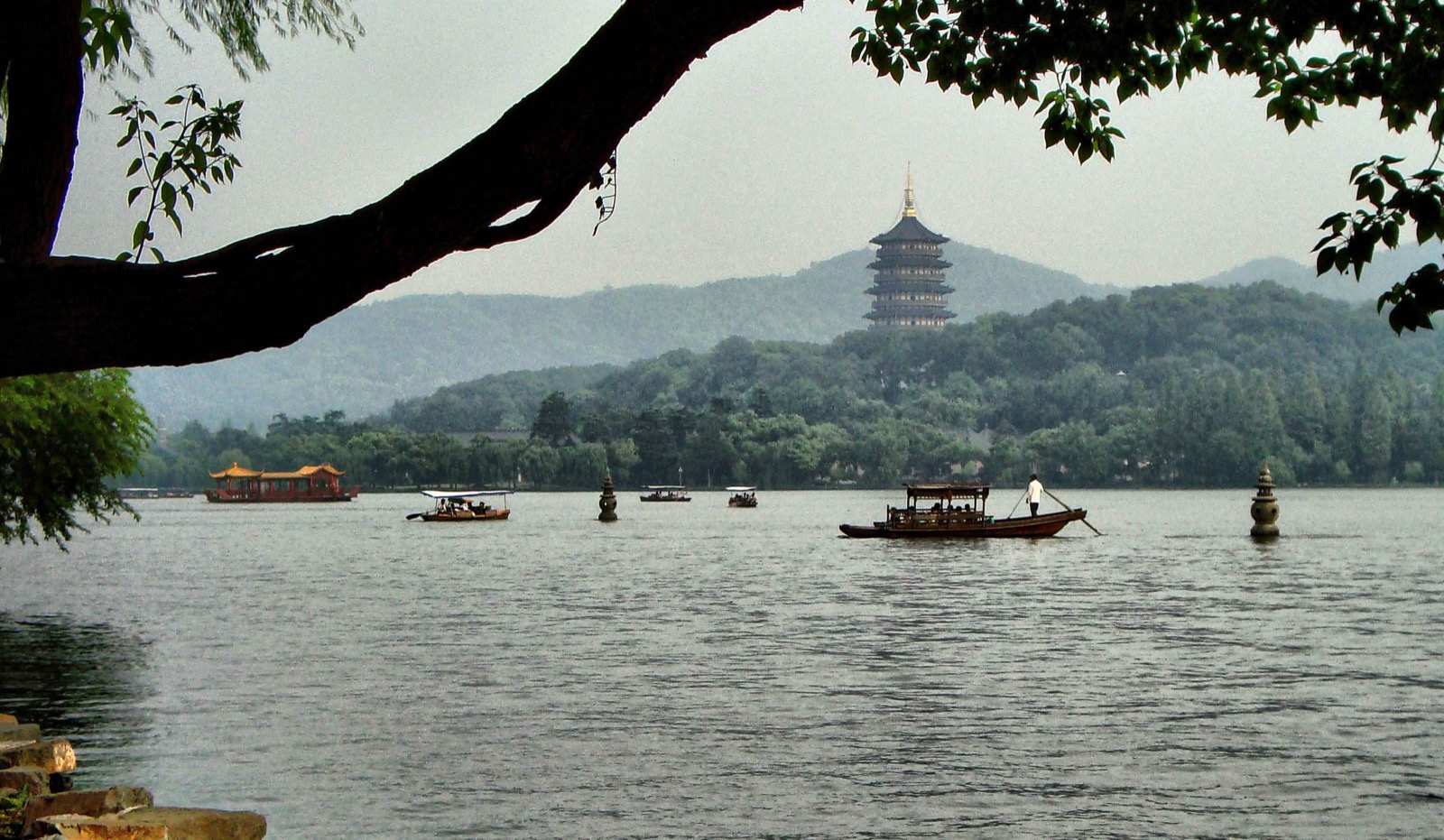
The heart of Hangzhou and a UNESCO World Heritage Site. The lake is free to walk around; boat rides cost extra. The full circuit is about 15km (3-4 hours walking, 1-1.5 hours by bike). Key spots:
- Su Causeway (苏堤): The most famous causeway, with six bridges and willow trees. Beautiful in spring.
- Broken Bridge (断桥): Iconic bridge at the east end of Bai Causeway, famous for “Broken Bridge with lingering snow” in winter.
- Three Pools Mirroring the Moon (三潭印月): The iconic island with three stone pagodas in the water, featured on the 1 RMB banknote. Accessible by boat.
- Leifeng Pagoda (雷峰塔): Rebuilt in 2002 with an elevator, offering panoramic views over West Lake, especially beautiful at sunset. ¥40.
Lingyin Temple / 灵隐寺
One of China’s most famous and important Buddhist temples, founded in 328 CE. Set in a forested hillside with ancient grottoes and Buddhist carvings (Feilai Peak / 飞来峰). Approximately ¥75 combined ticket (~¥45 Feilai Peak + ~¥30 temple; verify current prices). Temple halls have some steps; Feilai Peak grottoes have uneven paths and stairs.
Longjing Tea Village / 龙井村
Terraced tea plantations in the hills west of West Lake, producing China’s famous Dragon Well (Longjing) green tea. Visit in spring (March-April) for tea picking season; tea tastings are available at tea houses and farms. You can hike from the village to Nine Creeks (九溪烟树), a scenic stream area.
China National Silk Museum / 中国丝绸博物馆
Free museum covering 5,000 years of silk production, near West Lake. Modern, well-curated, and worth an hour if you are interested in silk history. Closed Mondays.
Hefang Street / Southern Song Imperial Street / 河坊街
Historic pedestrian street with traditional architecture, snack stalls, craft shops, and tea houses. Free. Very touristy but atmospheric, especially in the evening. Good for snacks and souvenirs.
Xixi National Wetland Park / 西溪湿地
A large wetland park west of the city with boat tours through reed beds and waterways. ¥80. A nice half-day nature escape from the city. Less essential than West Lake for first-time visitors.
Classic Routes
See the 14-day route for a suggested route. See the 10-day balanced itinerary for a suggested route.
One perfect day
Morning: Walk West Lake’s Su Causeway or Bai Causeway (dawn is magical and less crowded) → take a boat to Three Pools Mirroring the Moon island.
Lunch: At a restaurant near the lake or in Hefang Street area.
Afternoon: Lingyin Temple and Feilai Peak (1.5-2hrs) → Longjing Tea Village for tea tasting if time permits.
Evening: Leifeng Pagoda for sunset views → Hubin musical fountain or Impression West Lake show.
2 days
- Day 1: Full West Lake circuit (walk/cycle sections, boat ride, Leifeng Pagoda sunset).
- Day 2: Lingyin Temple (morning) → Longjing Tea Village and Nine Creeks hike + tea tasting, OR Xixi Wetland Park.
Day trip from Shanghai
Take an early HSR from Shanghai Hongqiao to Hangzhou East (~1hr). Take metro/taxi to West Lake. Walk the causeways, take a boat, visit Leifeng Pagoda, lunch, see Lingyin Temple if time, return to Shanghai by evening. Note: this is rushed; an overnight stay is strongly recommended for the dawn/dusk lake atmosphere.
Food to Try
Hangzhou is the center of Zhejiang cuisine (one of China’s Eight Great Cuisines), known for fresh, delicate flavors, often sweet rather than spicy.
- West Lake vinegar fish (xihu cuyu / 西湖醋鱼): The iconic Hangzhou dish – grass carp from West Lake steamed and served in a sweet-sour vinegar glaze. Divisive (some find it too sweet/sour or the texture odd); try it for the experience.
- Dongpo pork (dongpo rou / 东坡肉): Slow-braised pork belly in soy sauce and rice wine, named after Song dynasty poet-governor Su Dongpo. Rich, fatty, and delicious when well-made.
- Longjing tea shrimp (longjing xiaren / 龙井虾仁): Fresh shrimp stir-fried with Longjing tea leaves. Light, fragrant, and elegant.
- Beggar’s chicken (jiaohua ji / 叫花鸡): Chicken stuffed with herbs and mushrooms, wrapped in lotus leaves and clay, then baked. The clay is cracked open at the table.
- Hangzhou xiaolongbao and noodles: Soup dumplings and noodle dishes, similar to Shanghai style but with local variations. Pian’erchuan (片儿川) is a famous local noodle soup.
- Longjing tea (龙井茶): One of China’s most famous green teas. Buy from reputable tea shops or directly from tea villages; prices vary enormously by grade. Pre-Qingming (明前) tea picked in late March-early April is the highest grade and most expensive.
Night Experience
- West Lake at night: The lake is beautifully illuminated along the eastern shore. The Hubin musical fountain (free, times vary) is popular. Walking the lakeside paths at night is peaceful.
- Impression West Lake (印象西湖): Night show directed by Zhang Yimou, performed on a submerged stage on West Lake. ¥260-600+. Atmospheric but touristy.
- Hefang Street at night: Lanterns, food stalls, and craft vendors. A good place for evening snacks.
- Hubin Yintai / Kerry Centre area: Upscale restaurants, bars, and shopping on the east side of the lake.
Best Time to Visit
- Spring (March-May): Peach blossoms, willow trees in new green, misty lake – peak beauty. Cherry blossoms late March-early April. Occasional rain.
- Early autumn (September-October): Comfortable temperatures (20-28C), osmanthus fragrance (Hangzhou is famous for sweet-scented osmanthus in October), clear skies. Excellent season.
- Mid-late autumn (November): Autumn colors around the lake.
- Summer (June-August): Hot (33-38C) and humid. West Lake lotus flowers are in bloom (beautiful), but the heat is oppressive. Start early.
- Winter (December-February): Cold (3-8C), occasional snow. “Broken Bridge with lingering snow” is a famous snow view. Fewer tourists and lower hotel prices.
- Avoid: Chinese National Day (Oct 1-7) and other major holidays – West Lake becomes extremely crowded.
Culture & History
- Southern Song dynasty capital (1127-1279): When the Song court was driven south by invaders, Hangzhou (then called Lin’an) became the imperial capital. It grew into one of the world’s largest and most prosperous cities of the era.
- West Lake poetry: For over 1,000 years, the lake has inspired poets and painters. Su Dongpo (1037-1101), Song dynasty poet and governor of Hangzhou, wrote famous poems about the lake and ordered the construction of Su Causeway, which still bears his name.
- Longjing tea: One of China’s most famous green teas, grown in the hills around West Lake for over 1,000 years. The tea is pan-fired by hand to stop oxidation, producing its characteristic flat shape and chestnut aroma.
- Grand Canal: The Beijing-Hangzhou Grand Canal (UNESCO), the world’s longest canal, terminates in Hangzhou. The canal was built in sections over 2,000 years and was a major transport route for grain, silk, and other goods.
- Marco Polo: The Venetian traveler allegedly visited Hangzhou in the late 13th century and called it “the finest and most splendid city in the world.” The accuracy of his account is debated, but the quote is widely used in Hangzhou tourism.
- Leifeng Pagoda: Originally built in 975 CE, collapsed in 1924, and was rebuilt in 2002 with modern elevators while preserving the original pagoda ruins visible at the base.
Accessibility & Tips
- West Lake promenade and main causeways are mostly flat and accessible. Su Causeway and Bai Causeway have gentle slopes but no steps.
- Lingyin Temple: Main temple halls are accessible via paths, but some areas have steps. Feilai Peak grottoes have stairs and uneven surfaces.
- Longjing Tea Village: Hilly roads and stepped paths in tea terraces; not suitable for wheelchairs/strollers.
- Leifeng Pagoda: Has elevator to top viewing level; fully accessible.
- China National Silk Museum: Modern building, expected to be fully accessible with elevators.
- Fitness: Relaxed: Hangzhou is designed for slow walking and cycling. Expect 10,000-15,000 steps/day. Less demanding than Beijing or Xi’an.
- Bring an umbrella or rain jacket: Hangzhou rains frequently, especially in spring.
- The lake is large: Don’t try to walk the full 15km circuit unless you enjoy long walks. Focus on the northern and western sections (Su Causeway, Bai Causeway) for the best scenery.
Common mistakes
- Trying to “do” West Lake in 2 hours – it’s a large area. The full circuit is 15km. Pick sections to explore slowly rather than rushing.
- Only eating at tourist restaurants near the lake – some excellent local food is in the old streets (Hefang Street area) and neighborhoods away from the immediate lakefront.
- Buying overpriced Longjing tea from tourist shops – prices near West Lake are inflated. Buy from tea villages (Longjing Village) or reputable brands. If a price seems too good to be true for pre-Qingming Longjing, it’s probably fake.
- Day-tripping from Shanghai without staying overnight – you miss the magical dawn and dusk atmosphere around the lake, when day-trippers have left and the lake is peaceful and illuminated.
- Visiting on Chinese holidays – West Lake and its causeways can be very busy during National Day, Spring Festival, and Labor Day breaks. Prefer an ordinary weekday and start early.
- Only seeing the lake and skipping Lingyin Temple – the temple is one of China’s greatest Buddhist sites and deserves 1.5-2 hours.
Sources
- West Lake UNESCO: https://whc.unesco.org/en/list/1334/