
Current visitor details
Hours, admission, booking and passport guidance below come from the Place record shared by city, itinerary and booking pages. Unverified or stale high-risk claims are not shown as facts.
Booking
Normal daytime visits do not require advance booking. Buy on arrival or use the official mini-program; carry the original passport if booking or buying under a passport number.
Plan ahead: Same-day purchase usually works except during peak holidays and Lantern Festival.
On site: Available at the north and south staffed ticket windows.
Channels: On-site ticket windows (north and south gates) · Official WeChat mini-program: 上海豫园
Opening and last entry
Tuesday-Sunday 09:00-16:30, with last entry at 16:00. Closed Mondays except national public holidays; Spring Festival arrangements may be announced separately.
Admission
DAY GARDEN: 40 RMB/adult from April 1-June 30 and September 1-November 30; 30 RMB/adult from July 1-August 31 and December 1-March 31. Eligible students and visitors aged 60+ pay half price with valid documents; children 1.3m or shorter or aged 6 and under enter free. The separate immersive night-tour product is not included in daytime admission and costs substantially more.
Visit planning
Allow: 60-90 minutes (garden only); add 1-2 hours for surrounding bazaar
Physical load: moderate
Enter through the main (south) gate, proceed through the Grand Rockery area, cross the Nine-turn Bridge area, visit the Inner Garden, and exit through the north gate toward the bazaar/City God Temple.
Getting there
Metro: Yuyuan Station (豫园站) on Lines 10 and 14. Exit 1 or 3, walk approximately 5 minutes to the garden entrance in the Old City/City God Temple area.
Accessibility
- Wheelchair access: Classical garden with uneven stone paths, steps, narrow bridges, and rockeries. Wheelchair access is very limited. Strollers are possible but difficult. The official notice says 'if you must use a stroller or wheelchair, please pay attention to safety' — indicating it is possible but not designed for it.
- Luggage storage: Officially confirmed: no luggage storage available (因条件限制,园方暂时无法提供行李寄存服务).
- Restrooms: Available within the garden.
Who this visit suits
Yu Garden is best for first-time Shanghai visitors wanting a classical Jiangnan garden without a Suzhou day trip, for photographers chasing traditional architectural detail, and for travelers combining old-town atmosphere with nearby street food. It works as a half-day cultural stop before or after the Bund. It is not ideal for visitors expecting the scale and serenity of Suzhou’s great gardens – Yu Garden is compact, often extremely crowded, and surrounded by a heavily commercialized tourist district. Mobility-limited visitors will struggle with stone steps, narrow bridges, and uneven rockery paths; there is no step-free route through much of the garden. There is no luggage storage on site.
A route that makes sense
- Enter through the main Fuyou Road gate (north entrance, facing the bazaar).
- Step into Sansui Hall (Three Corn Ears Hall), the first courtyard, and look up at the carved wood beams.
- Climb the Grand Rockery (Huangshan Jia), the 14-meter yellow-stone rockery by Ming master Zhang Nanyang, for a rooftop-like view over tiled roofs; the path winds through caves and crevices.
- Cross to Wanhua Chamber (Ten Thousand Flower Tower) and pause at Jade Water Corridor and the fish pond.
- Find the Exquisite Jade Rock (Yulinglong), the 5-ton perforated Taihu stone counted among the three great Jiangnan scholar’s rocks; note how light passes through its holes when backlit.
- Walk along the dragon walls snaking between zones, counting the dragon heads at the wall ends.
- Pause at the Hall of Jade Magnificence (Yuhua Tang) and the Inner Garden (Nei Yuan), the smaller attached courtyard once part of the City God Temple.
What to notice
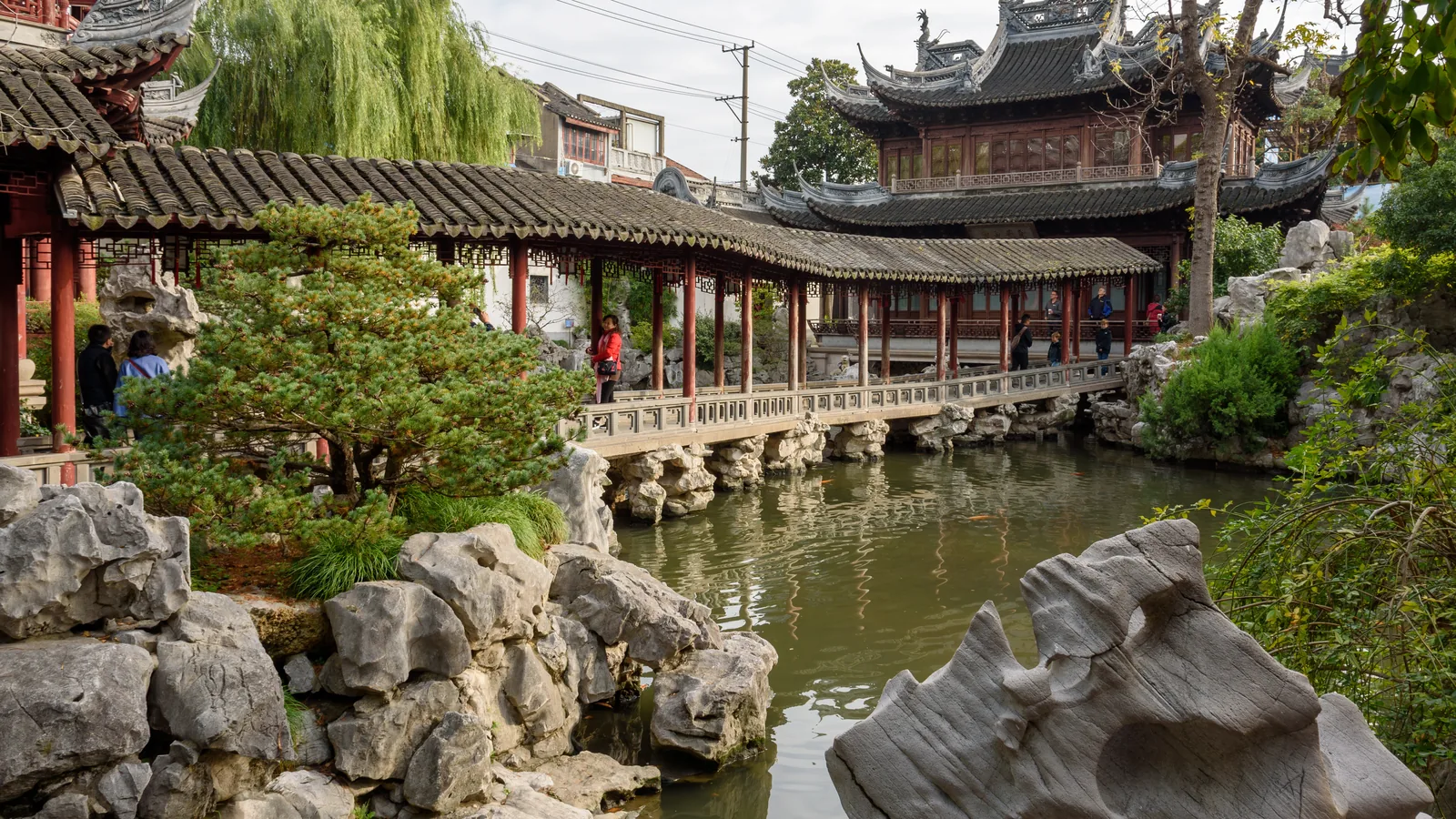
The Grand Rockery is the garden’s most important feature and one of the finest surviving Ming-dynasty yellow-stone rockeries, designed by Zhang Nanyang in the 16th century. Rough yellow stones from Yixing are stacked to evoke wild mountain scenery – peaks, cliffs, caves, winding paths – in barely half an acre; from the summit you look over grey tiled roofs. The Exquisite Jade Rock (Yulinglong) is the other treasure: a roughly 5-ton Taihu limestone eroded into a porous, honeycombed form with 72 named holes; legend says incense at its base sends smoke curling through every opening. The dragon walls are Yu Garden’s signature motif – undulating grey-tile ridges terminating in sculpted dragon heads; each differs slightly, and counting them is a quiet game. Look for stone lions guarding doorways (female with a cub, male with a ball), brick carvings over lintels, and calligraphy plaques above each hall. The Inner Garden, added in 1709 and connected to the main garden only since the 1950s restoration, is smaller and often less crowded.
Accessibility, fitness and conditions
Yu Garden is not meaningfully wheelchair accessible. It is built around rockeries with stone steps, narrow bridges, raised thresholds, and uneven flagstones; there is no step-free route to the Grand Rockery summit or through several zones. Wear flat, grippy shoes; stone steps are slippery after rain. The garden is mostly outdoors, so bring an umbrella on wet days. Summer (June-August) is hot and humid. Crowds dominate the experience: weekends, public holidays (Spring Festival, May Day, National Day), and summer afternoons can become extremely dense. Arriving at opening on a weekday is the best way to experience the garden calmly. The bazaar is flat and paved, though equally crowded at peaks.
How to combine it with nearby places
Yu Garden sits in the old-town district of Nanshi and pairs naturally with other central Shanghai places. It is a short taxi or Metro ride from The Bund; many visitors do Yu Garden and the bazaar in the late morning, eat Shanghai snacks for lunch, then walk or ride to the Bund for a late-afternoon stroll and evening lights. A full-day old-Shanghai route continues west into the French Concession for tree-lined avenues and cafes. For a bohemian contrast, Tianzifang is a taxi ride southwest and works as a late-afternoon wander after the garden. Avoid combining Yu Garden with distant sights like Zhujiajiao Water Town or Disneyland the same day.